Rigs, knots and baits
This notebook brings together what you need to know to go from a box of hooks to a line that fishes: the components, seven knots, eleven rigs and ten baits of the Ivorian coast. Each sheet follows the same order: what it is for, which fish, the tackle, the rig step by step, the bait, the adjustment and the pitfall to avoid. The figures come from the species sheets, cited by their number.
The line and its components
A line reads from top to bottom: the main line carries everything, the thinner leader connects the hook. The float supports and signals, the sinker weighs down, the swivel connects without twisting. A hook's number goes up as the hook gets smaller: a No. 12 is small, a 6/0 is large.
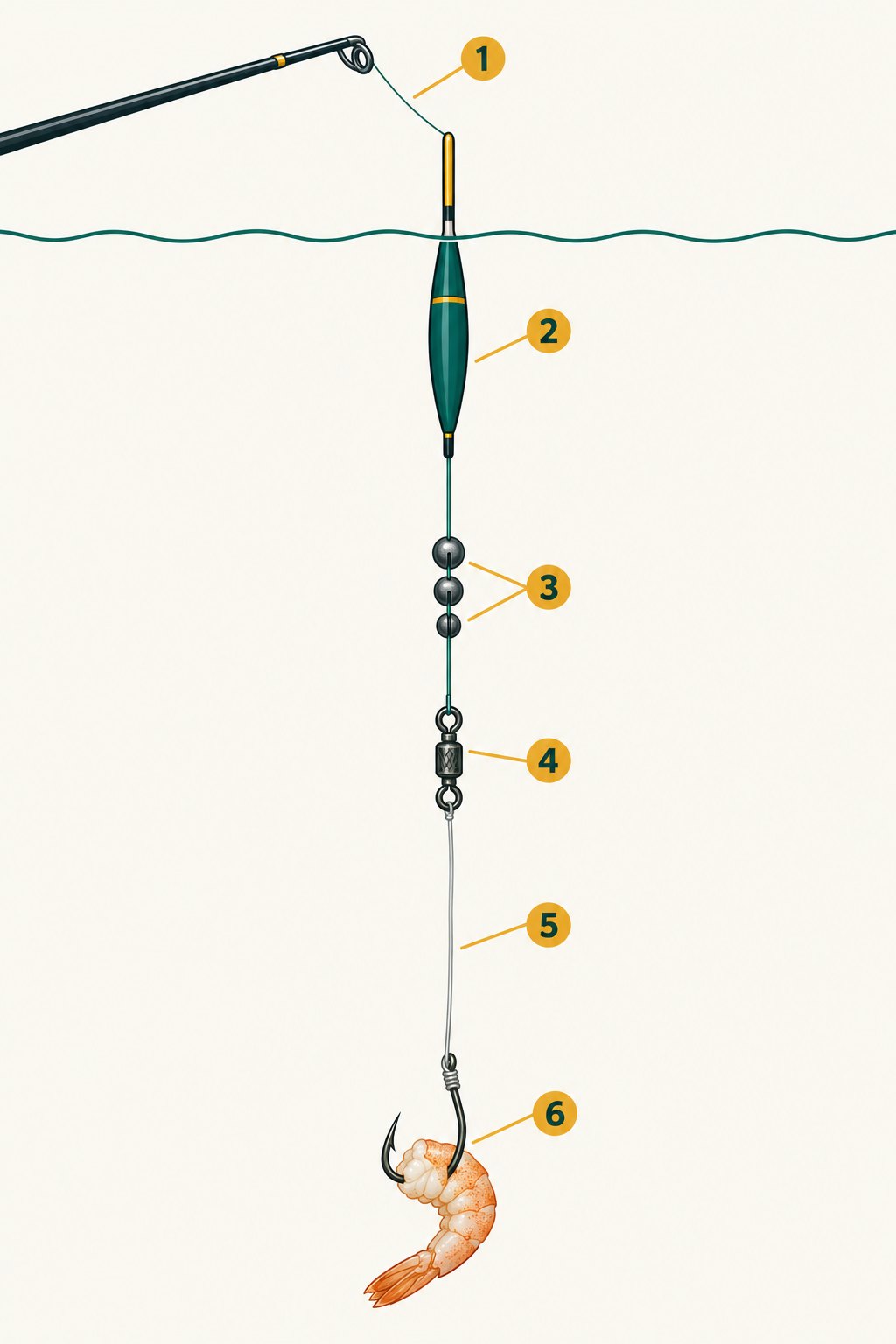
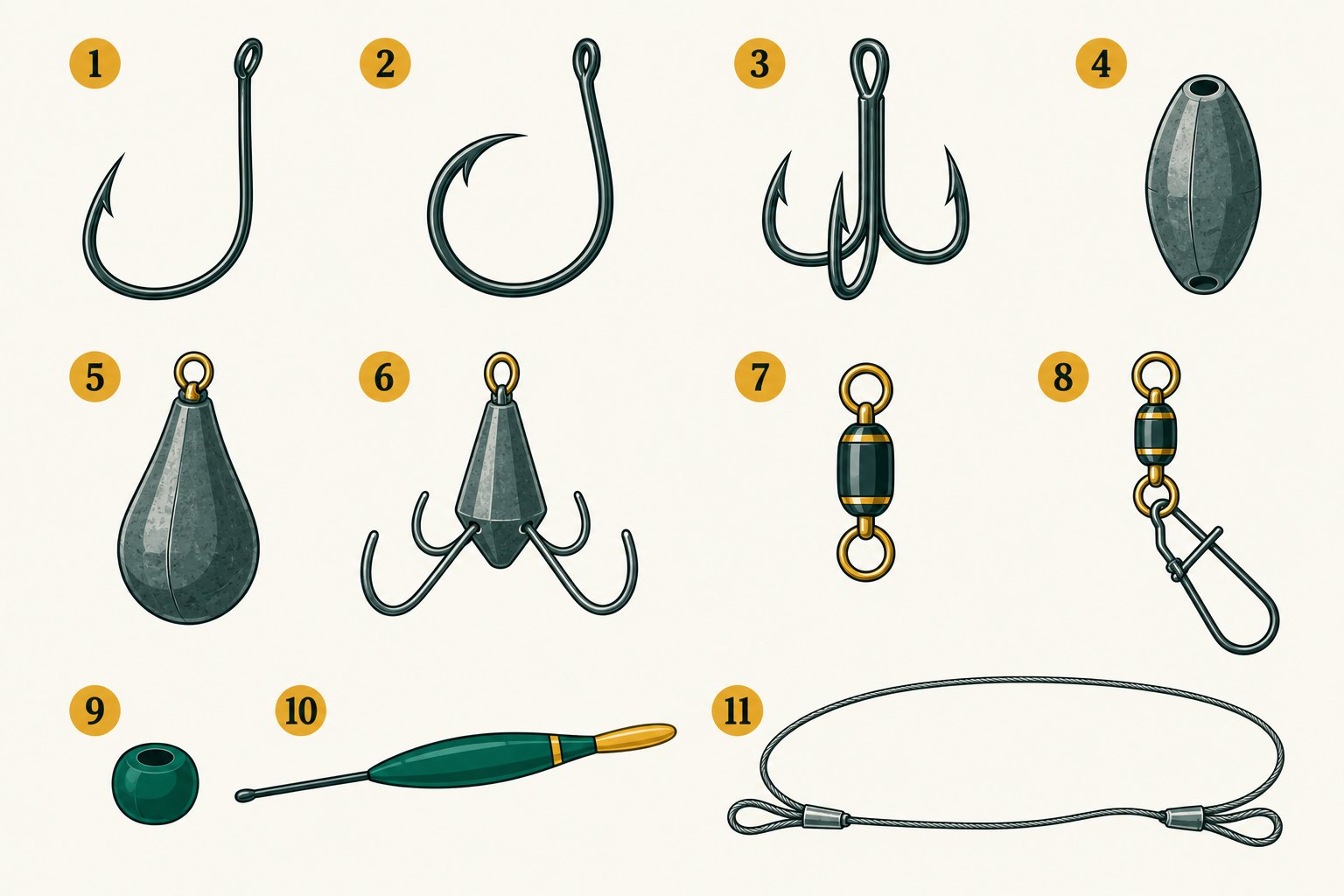
Nylon, fluorocarbon, braid: nylon is forgiving thanks to its stretch, fluorocarbon is less visible in water and resists abrasion, braid has no stretch and transmits the slightest bite. Most rigs in this book combine a fine braid with a fluorocarbon leader.
Seven knots are enough
Learn them at home, in peace and quiet. Universal rule: always wet the knot before tightening, as friction heat damages nylon. Test every knot with a firm pull: a knot that is going to break will break now, not on the fish of the year.
The Palomar knot
Use: Tying on a hook, swivel or lure. The most secure of the attachment knots, in nylon as in braid.
See it in 3D, step by step The full sheet
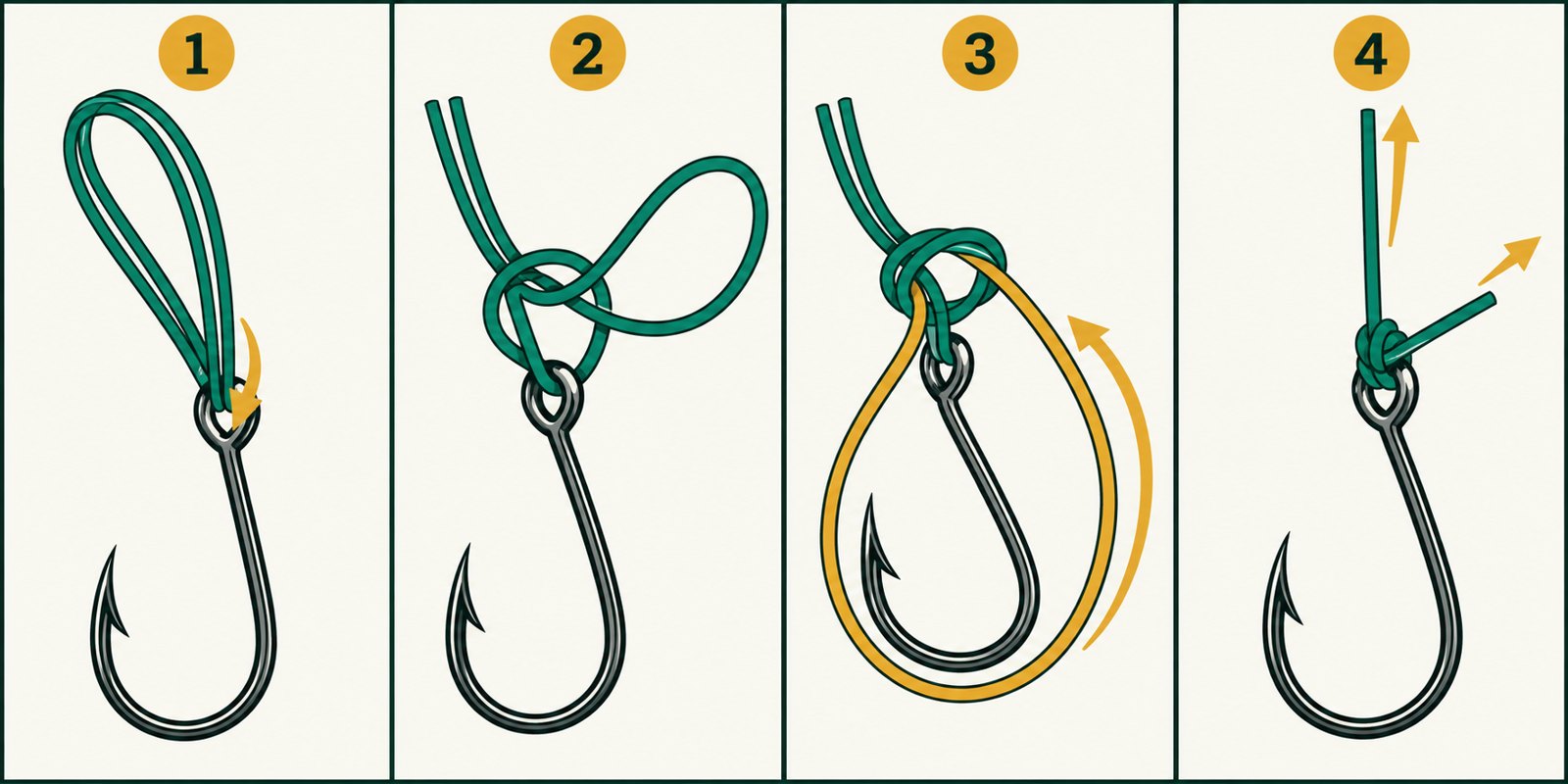
- double the line and pass the loop through the eye
- tie a loose overhand knot with the doubled line
- pass the whole hook through the loop
- wet, pull on both strands, trim short
The improved clinch knot
Use: The quick attachment for nylon up to 0.50 mm. Above that, or with braid, prefer the Palomar.
See it in 3D, step by step The full sheet
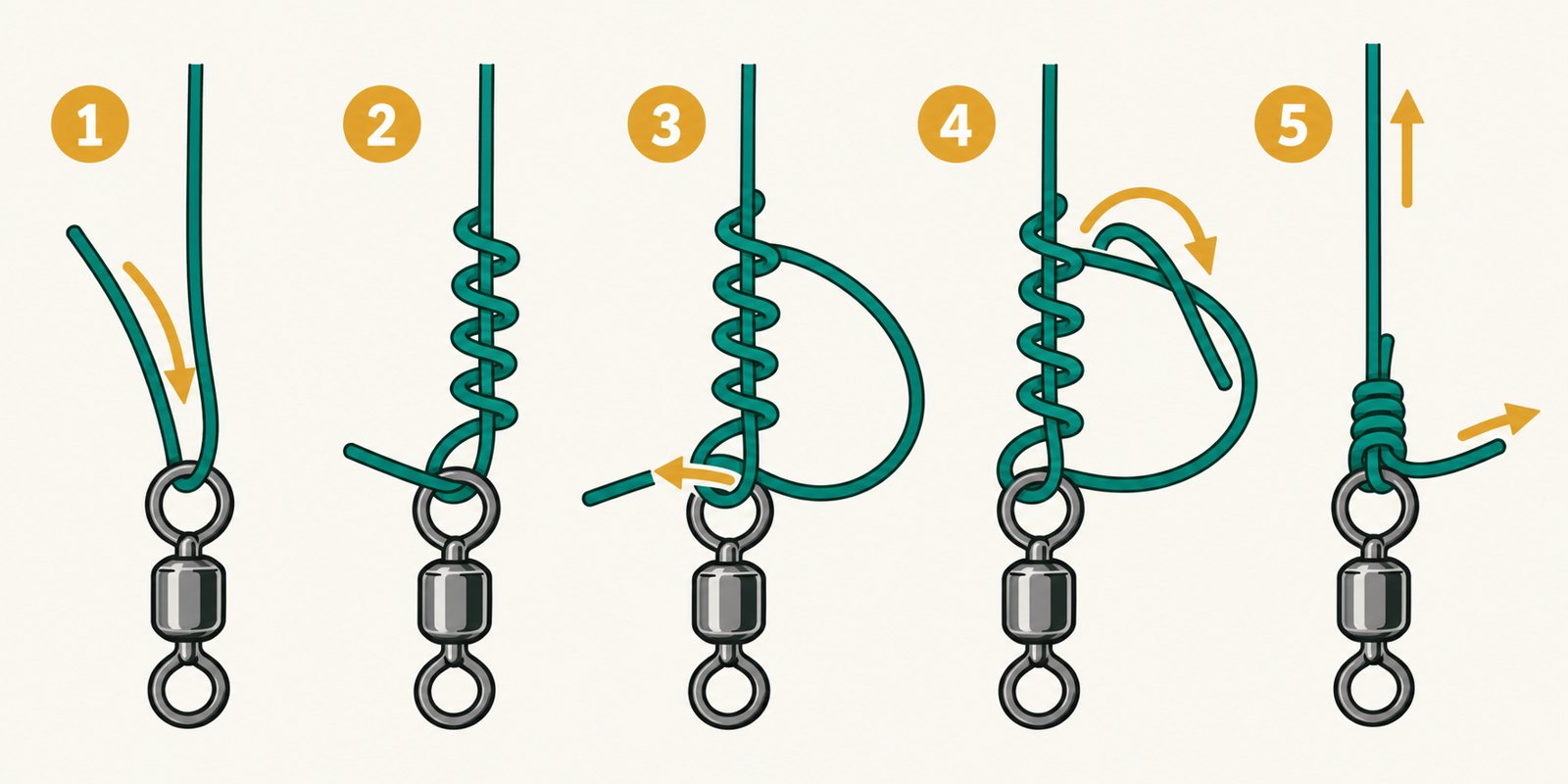
- pass the tag end through the eye
- make five turns around the line
- pass the end back through the small loop near the eye
- then through the large loop thus formed
- wet and tighten
The perfection loop
Use: An in-line loop for attaching a swivel, sinker or pre-tied leader. It lets you tie ready-to-loop leaders at home.
See it in 3D, step by step The full sheet
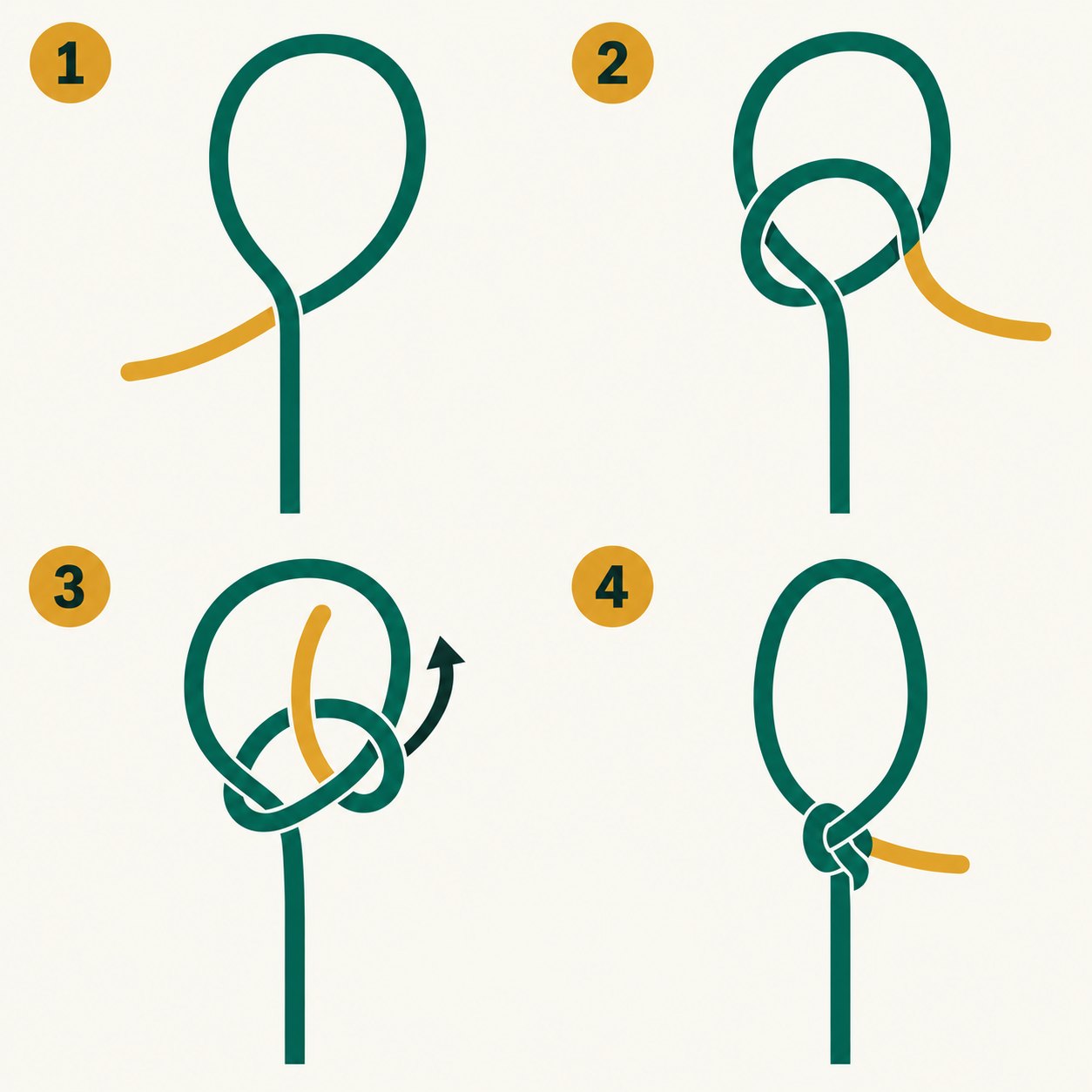
- form a first loop, the tag end passing behind the line
- form a second loop in front of the first
- pass the tag end between the two loops, then pull the second loop through the first
- wet, tighten: the loop stays in line with the main line
The dropper loop
Use: Holding a snood perpendicular to the line without twisting: handline, two-hook surfcasting rig, sabiki-style feather rig.
See it in 3D, step by step The full sheet
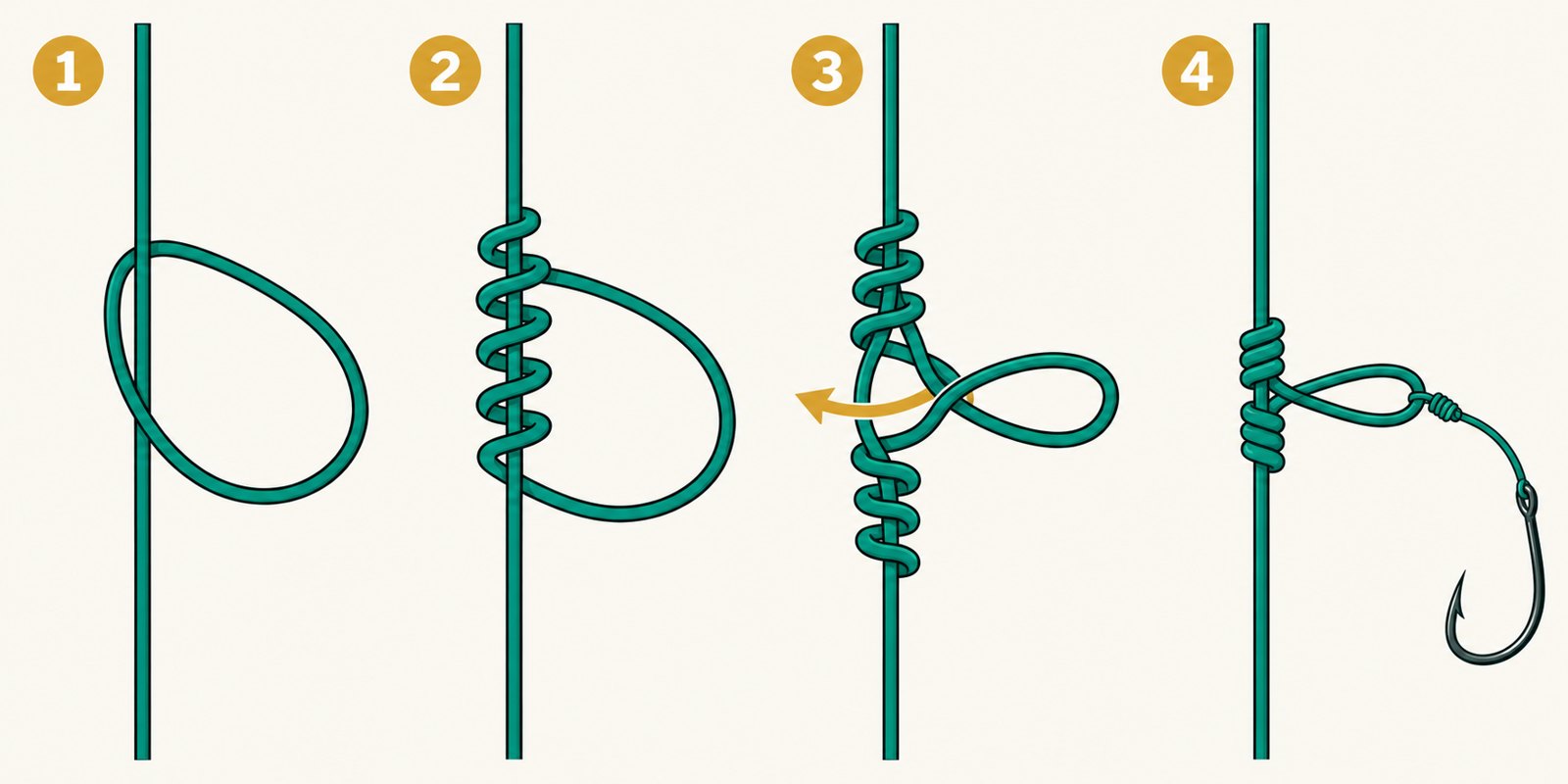
- form a large loop in the line
- twist the loop around itself six times
- open up the centre of the turns and pass the loop through this opening, between the two groups of turns
- wet, tighten on both sides: the dropper stands out perpendicular
The Albright knot
Use: Joining a fine braid to a thick fluorocarbon or nylon leader. Species sheets 11 and 16 also mention the FG and PR knots, which are slimmer and best left to expert anglers.
See it in 3D, step by step The full sheet
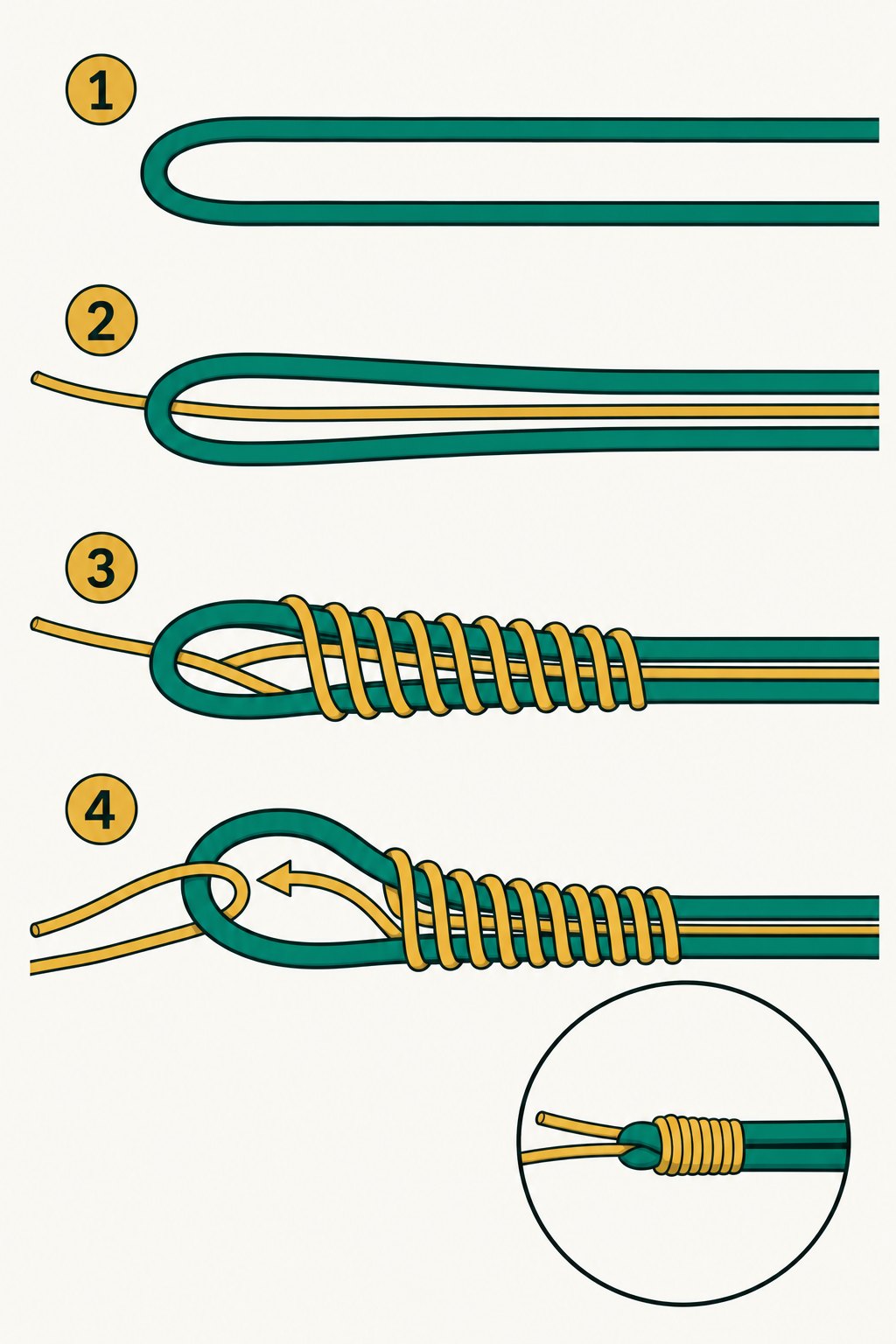
- form a loop in the thick line
- pass the braid through the loop
- make ten tight turns around the three strands, working back towards the top of the loop
- pass the tag end back through the loop: it comes out on the same side as the main strand; wet, tighten gradually, trim
The surgeon's knot
Use: Joining two nylon lines in thirty seconds, at night, in the rain. The universal quick fix.
See it in 3D, step by step The full sheet
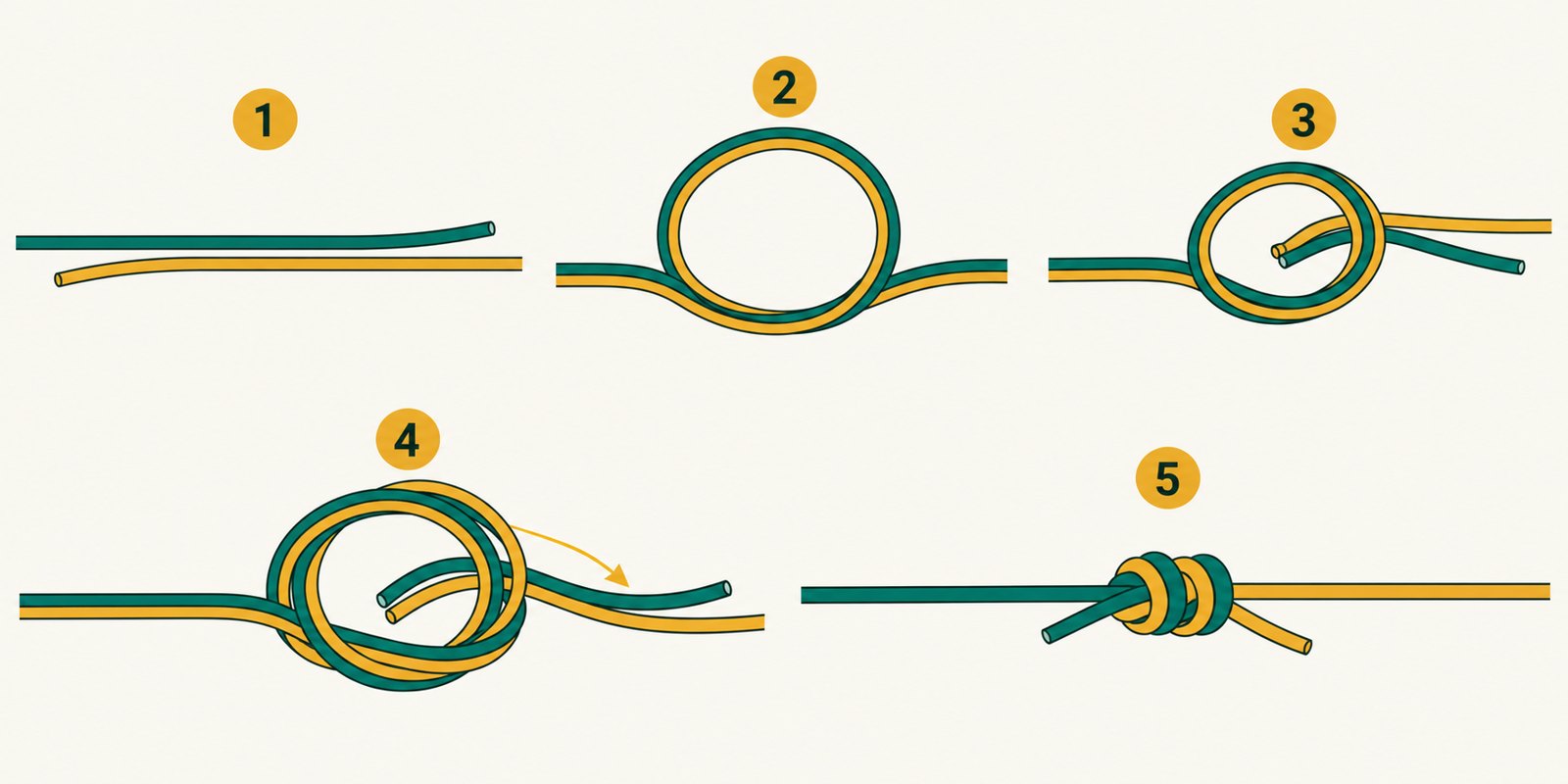
- lay the two lines side by side, in opposite directions
- form a loop with the two lines held together
- pass both ends through it together a first time
- then a second time through the same loop
- wet, pull on all four strands
Spade end hook knot
Use: Tie a spade end hook, with no eye, to a fine leader: pole fishing, small hooks for sardinella, mullets and lagoon fish. Seven to ten tight turns, from the spade towards the bend: the turns clamp the line against the shank and the spade stops them slipping.
See it in 3D, step by step The full sheet
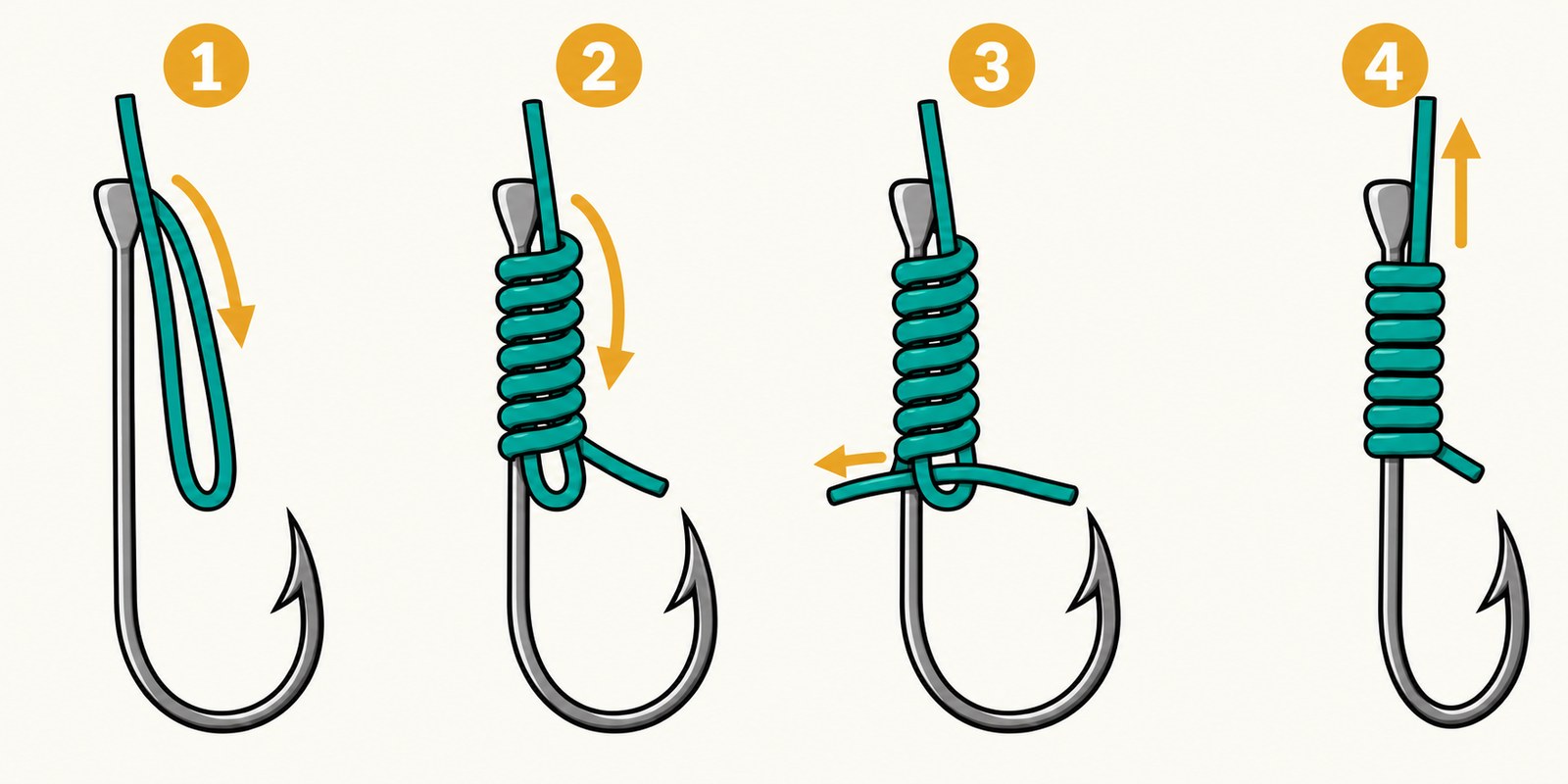
- lay the line along the shank, on the point side, and form a loop towards the bend
- wrap the tag end around the shank and both strands, from the spade towards the bend: seven tight turns
- pass the tag end back through the loop
- moisten, pull the main line: the loop closes under the coils and the line exits in front of the spade, on the point side
Six other knots, each with its own sheet: Snell knot, Uni knot, Double uni knot, Rapala knot, Trilene knot, FG knot.
Rigs, from beginner to expert
The lagoon running ledger rig
For : Bagrid catfish 63, Grogneur sompat (Sompat grunt) 42, Cassava croaker 75, Otolithe nanka (Longneck croaker) 76
The bait lies on the bottom; the line slides through the sinker, so the fish takes the bait without feeling any resistance. It is the all-round lagoon rig.
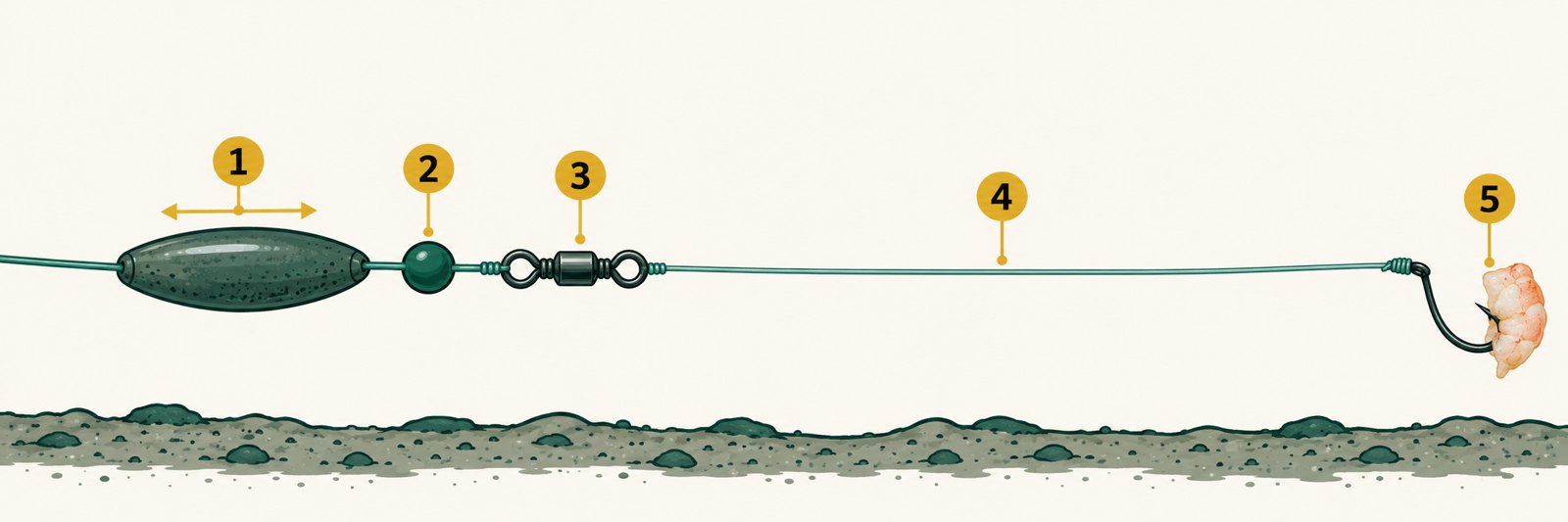
Rod of 3 to 4 m or handline; nylon main line 0.25 to 0.35 mm; olive sinker of 10 to 30 g depending on the current; bead; swivel; 40 cm leader; hook No. 6 to 1/0 depending on the bait (V13, Part III, chapter 1).
The rig step by step
- thread the olive sinker and then the bead onto the main line
- tie on the swivel (Palomar or clinch)
- tie 40 cm of leader to the other ring
- tie on the hook
- bait up, cast at the foot of a drop-off, tighten gently
Bait: Lagoon shrimp, piece of fish, mud worm, smelly paste for bagrid catfish.
Setting and technique: Sound the depth first: the spot is the foot of the drop-off between mudflat and hole. On the bite, give line for a second, then strike smoothly.
The sliding float, and the fine line
For : Blackchin tilapia 62, Flathead grey mullet 68, Mulet curème (Sicklefin mullet) 69
The float slides up the line to the stop knot: you fish in midwater at the chosen depth, even deeper than the length of the rod. In a fixed, very fine version, it is the line for “carpes” (tilapia) and mullets.
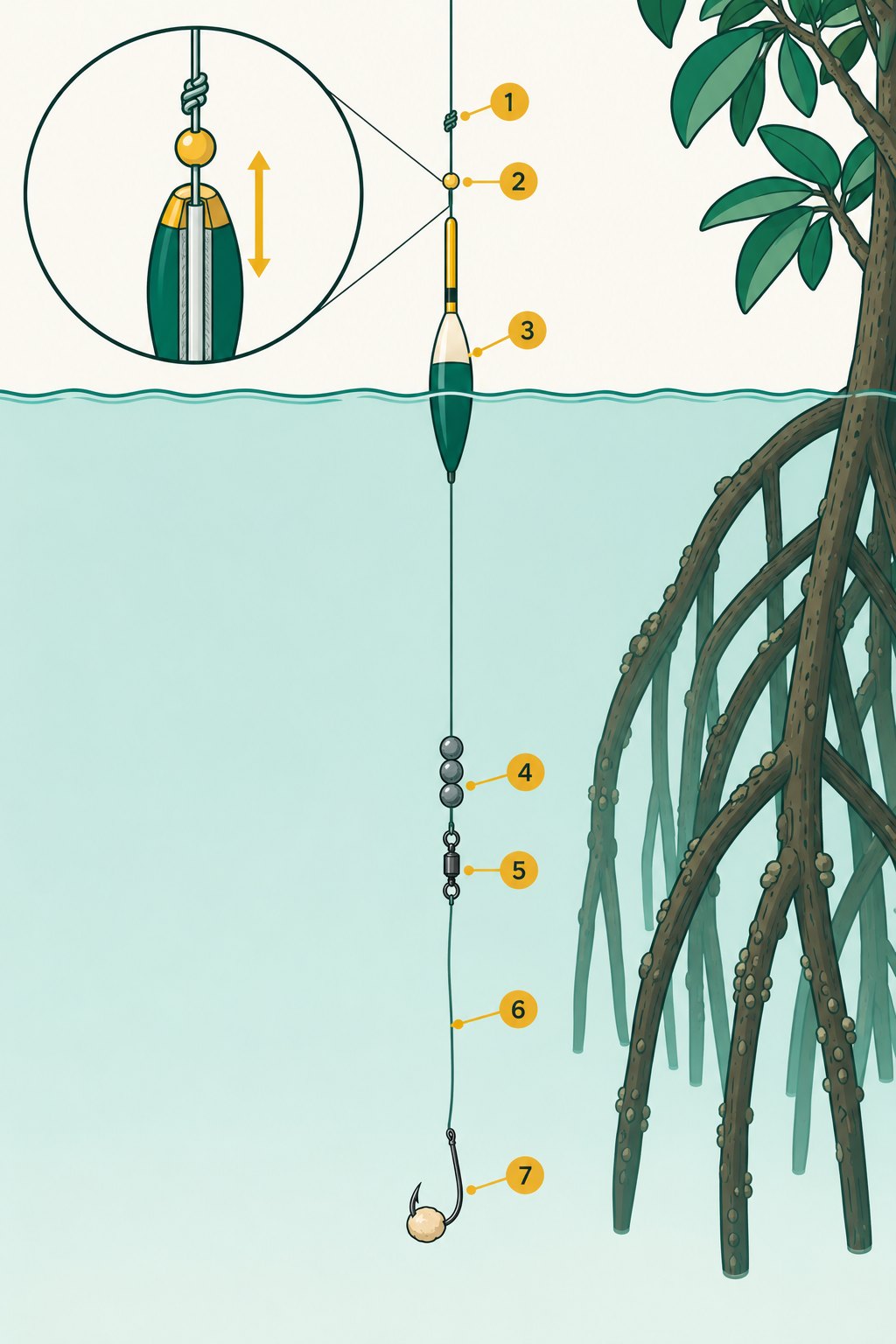
Fine line: rod of 3 to 5 m, nylon 0.14 to 0.22 mm, fine balanced float, leader 0.12 to 0.20 mm, hook No. 8 to 14 (species sheets 62, 68, 69). Sliding float: stop knot, bead, tube float, bulk shot, swivel, leader.
The rig step by step
- tie the stop knot on the main line at the chosen depth
- thread on the bead and then the float
- pinch the shot on under the float, the smallest last
- tie on the swivel, leader and hook
- balance it: only the antenna should show
Bait: Bread paste, semolina, maggot, worm; groundbait lightly to hold the school of mullet.
Setting and technique: Shy bite: strike gently. Use the smallest float possible for the wind and current.
The handline
For : Bagrid catfish 63, Cassava croaker 75, Otolithe nanka (Longneck croaker) 76, Canary dentex 31, Pagre à points bleus (Bluespotted seabream) 34, Pageot à têche rouge (Red pandora) 35, West African goatfish 37
A handline or rod, weighted to the bottom, armed with two or three snoods on dropper loops above the sinker. The school of Ivorian fishing.
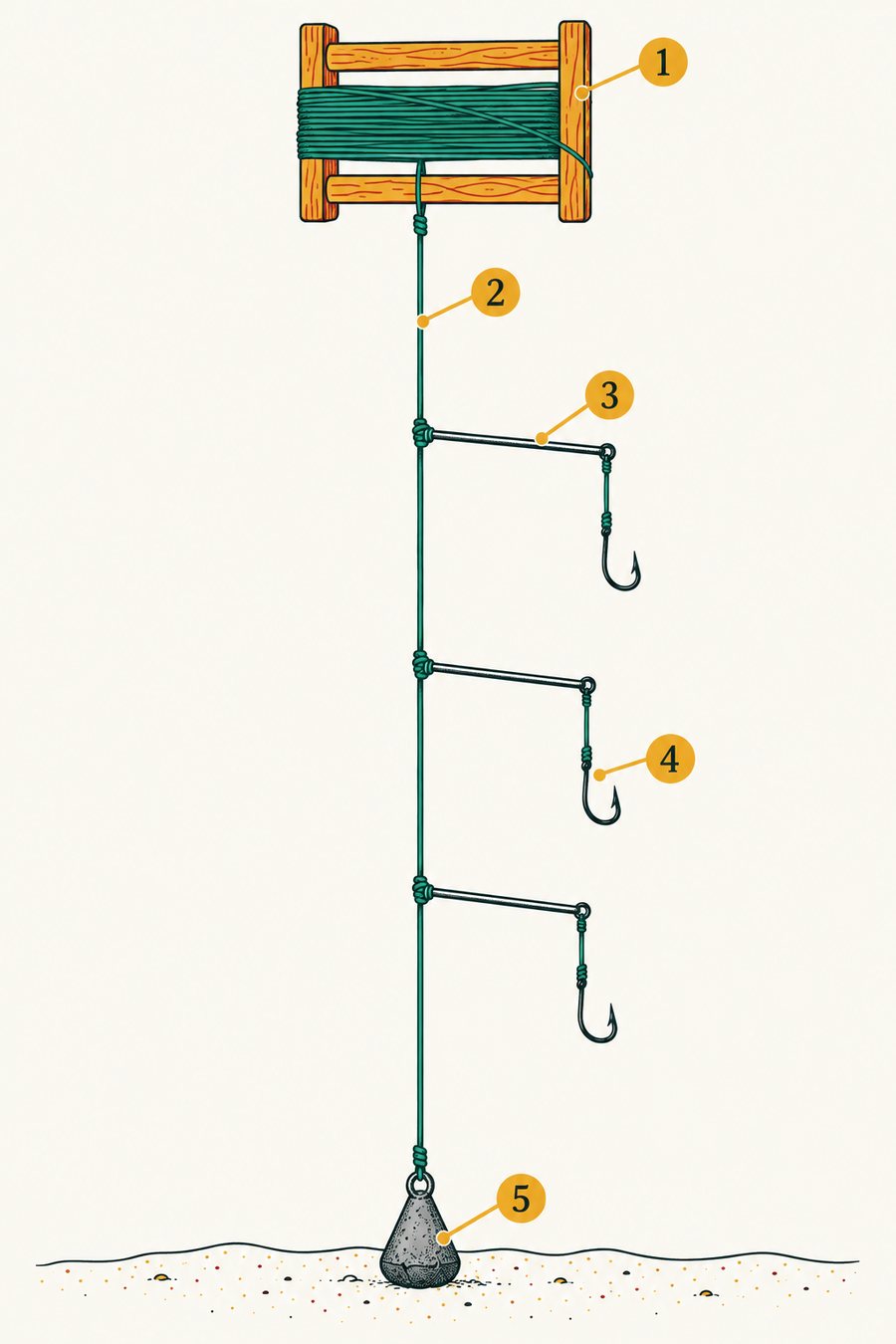
Line winder or rod; nylon main line; snoods tied with dropper loops; hooks; sinker at the end.
The rig step by step
- tie the sinker to the end of the line
- tie two or three spaced dropper loops above it
- tie a snood and its hook on each dropper loop
- let it down to the bottom, wind up one turn
- keep the line between your fingers to feel the bite
Bait: Shrimp, marine worm, chunk of sardinella, strip of squid.
Setting and technique: Drifting over holes, lift often to check the baits.
The deep handline
For : White grouper 29, Mérou de Gorée (African hind) 30, Vivaneau à dents de chien (African brown snapper) 38, Vivaneau guinéen (African red snapper) 39, Vivaneau doré (Golden African snapper) 40, Vivaneau de Gorée (Gorean snapper) 41, Canary dentex 31, Denté à bosse (Pink dentex) 32, Denté de l'Angola (Angolan dentex) 33, Pagre à points bleus (Bluespotted seabream) 34
The heavy version of the handline, over the rock heads along the edge of the canyon.
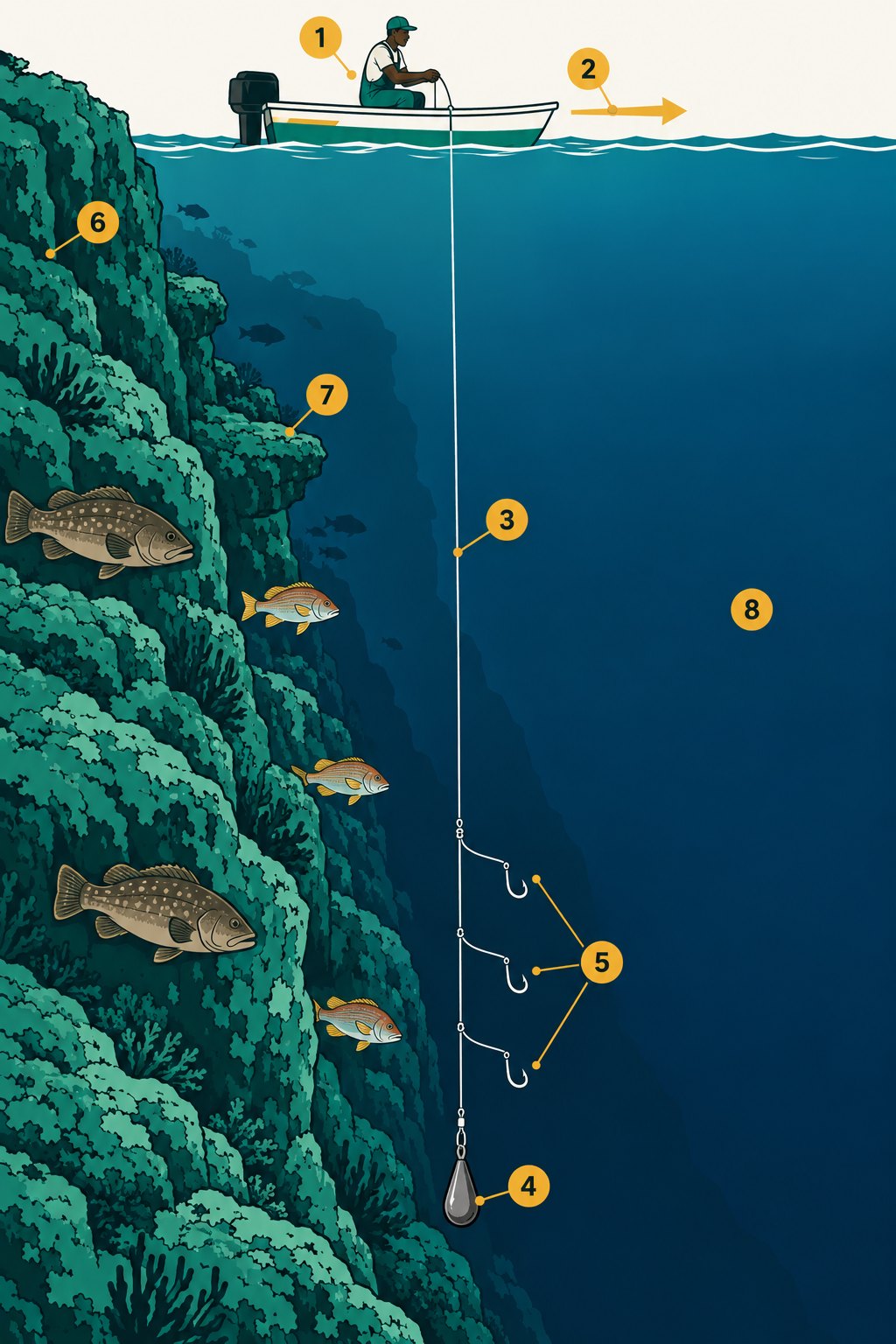
Line 0.60 to 0.80 mm or braid; sinkers of 300 to 500 g; pre-tied snoods; hooks 1/0 to 5/0 (V13, deep handline checklist).
The rig step by step
- prepare the snoods on land
- let it down to the bottom in a controlled drift
- wind up one or two turns to lift the sinker off the bottom
- strike firmly and pump without letting the fish get back to the rock
Bait: Sardinella, squid.
Setting and technique: The drift over the canyon quickly becomes strong: watch your position in relation to the walls.
Two-hook surfcasting
For : Grand capitaine (Giant African threadfin) 70, Petit capitaine (Lesser African threadfin) 71, Cassava croaker 75, Otolithe nanka (Longneck croaker) 76, Grogneur sompat (Sompat grunt) 42, Grogneur de Roger (Pigsnout grunt) 43, Grogneur métis (Bastard grunt) 44
The bait is cast just beyond the first bar; the grapnel sinker holds despite the swell and the snoods present two baits.
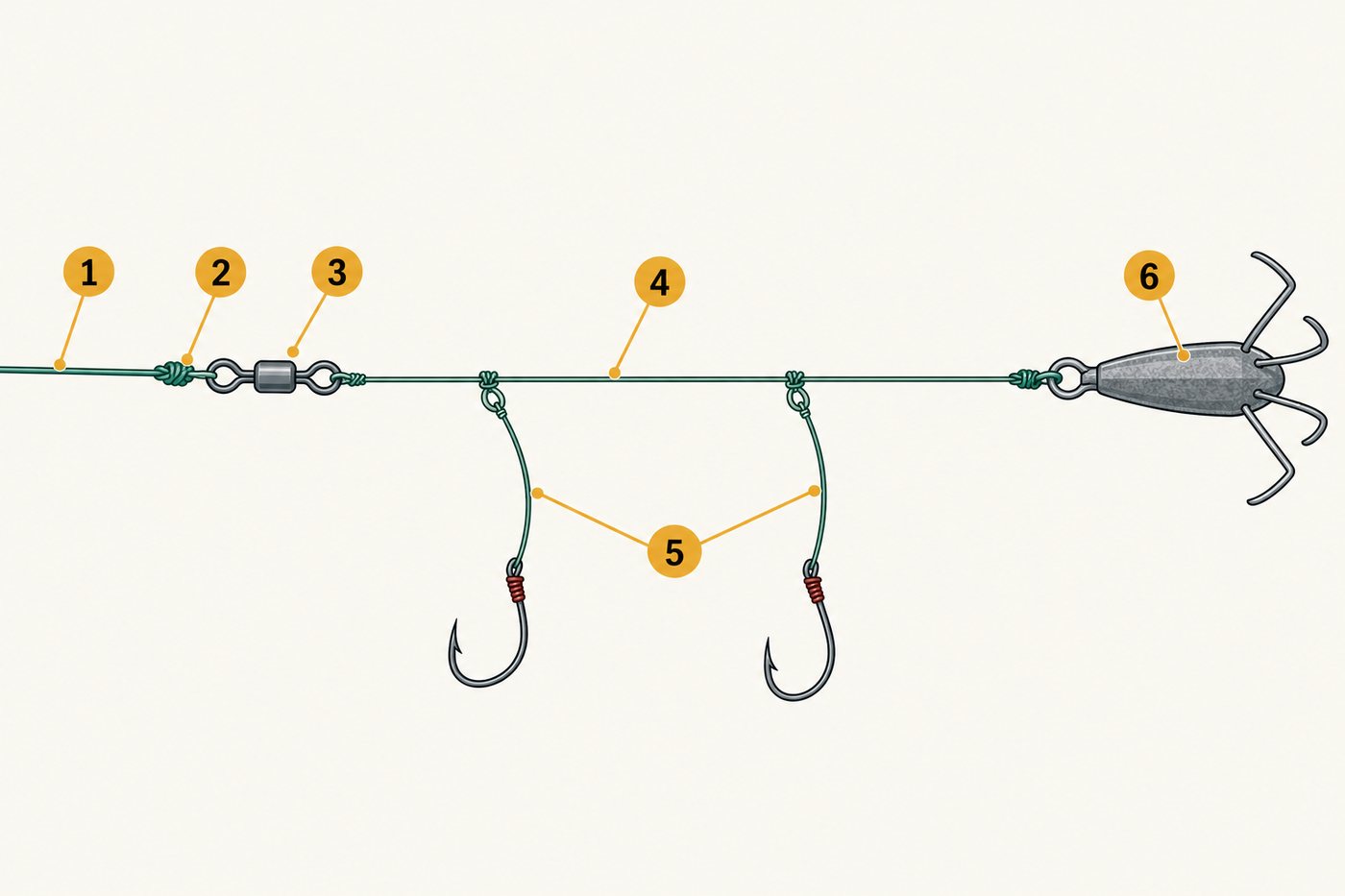
Rod of 4 to 4.5 m, 100 to 200 g; 8000 reel; nylon 0.35 mm or braid with a shock leader; grapnel sinker of 100 to 150 g; leader 0.50 to 0.60 mm (V13, Part III, chapter 2). Big threadfin: rod 4.20 to 4.80 m, fluorocarbon leader 60 to 100 lb, hook 3/0 to 6/0 (species sheet 70).
The rig step by step
- tie the shock leader (a stronger length at the head of the line) to the main line
- tie on the swivel and the leader
- tie two dropper loops and their snoods
- tie the grapnel sinker at the end
- bait up, cast beyond the first bar, set the rod on a rod spike and tighten
Bait: Marine worm, crab, shrimp, sardinella.
Setting and technique: Rising tide at dusk and for two hours after nightfall.
Live bait
For : Guinean barracuda 25, Crevalle jack 16, Grand capitaine (Giant African threadfin) 70, White grouper 29, Mérou de Gorée (African hind) 30, Mafou (Cobia) 28
A small live fish swims at the end of the line: it is the king of baits for big predators.
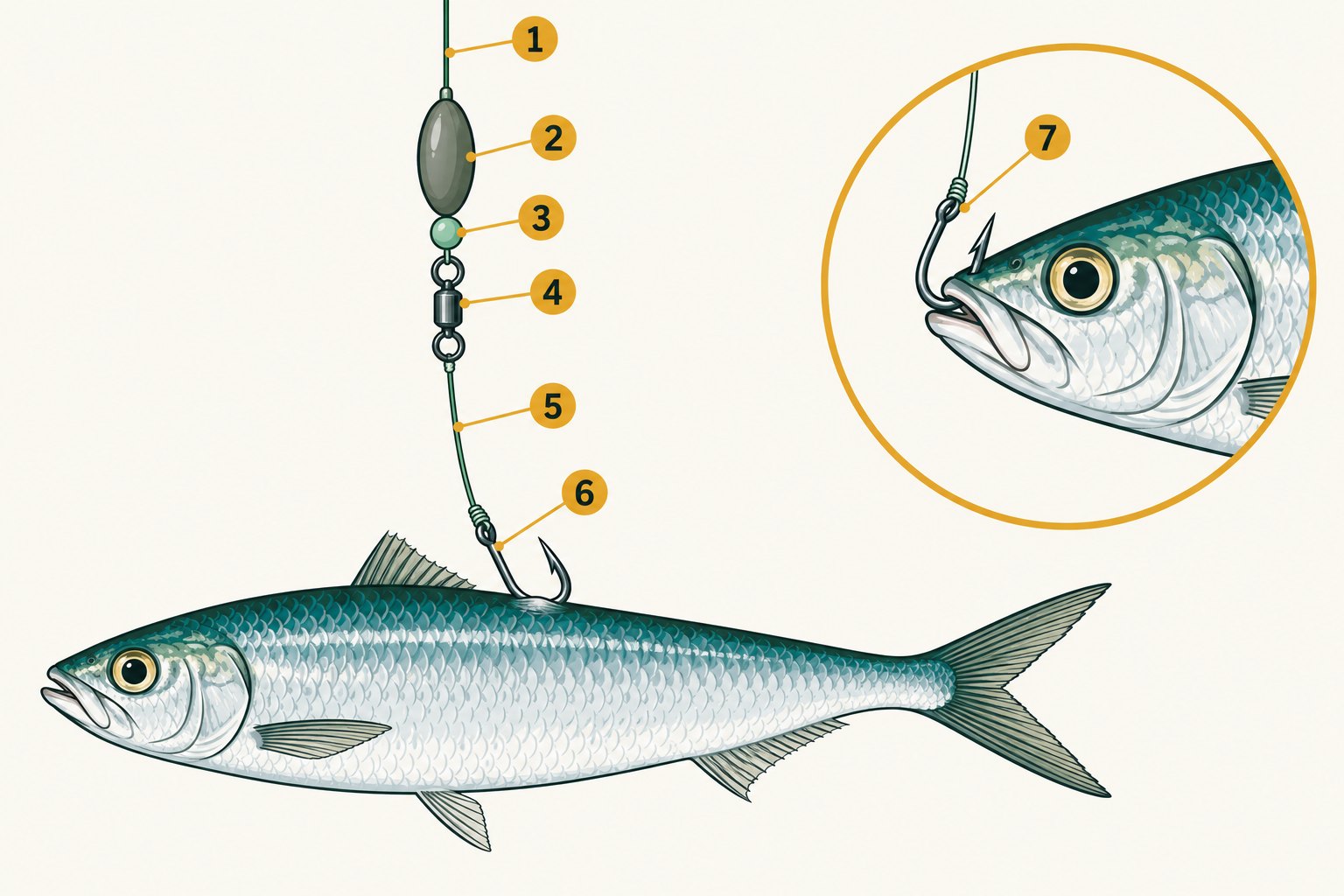
Sliding rig: olive sinker, bead, swivel, leader; hook suited to the size of the live bait. Steel as soon as barracudas are about.
The rig step by step
- tie the sliding rig as for bottom fishing
- hook the live bait under the skin of the back behind the dorsal, or through both lips
- cast gently, without tearing the live bait off
- let the predator swallow for a few seconds before striking
Bait: Sardinella or bonga shad, caught at dawn with a dip net or fine line.
Setting and technique: Keep live baits in an aerated live well or a bucket with frequently changed water: a sluggish live bait is a dead bait.
The heavy bottom rig for rock
For : White grouper 29, Mérou de Gorée (African hind) 30, Denté à bosse (Pink dentex) 32, Vivaneau à dents de chien (African brown snapper) 38, Vivaneau guinéen (African red snapper) 39, Rascasse de Kuhl (Offshore rockfish) 55, Diagramme gris (Rubberlip grunt) 45
A short, strong leader and a sinker on a weak link: you pull the fish out of its hole and, if the sinker snags, you lose only the sinker.
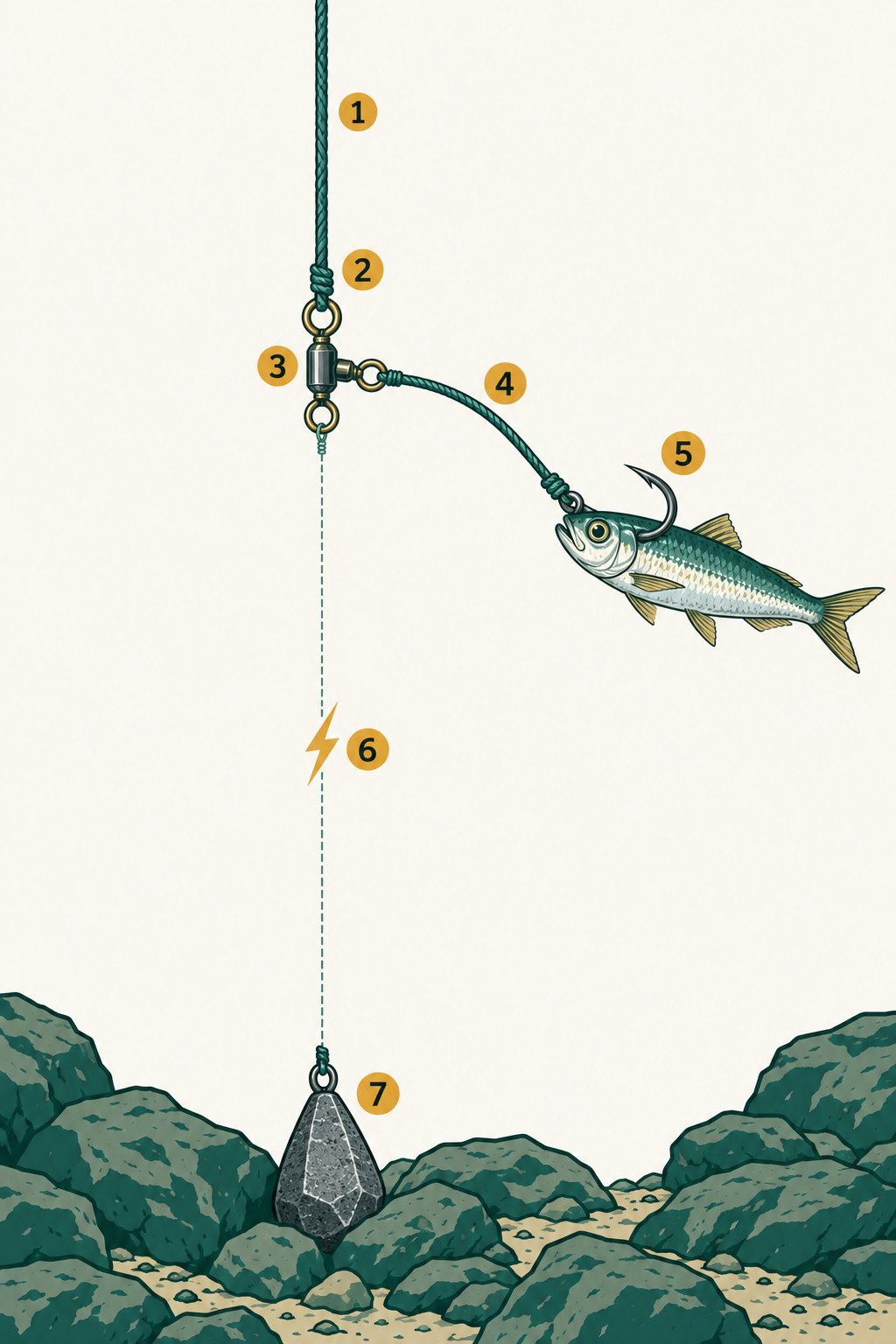
Powerful 2.10 m rod, 30 to 80 lb; braid PE 4 to PE 10; fluorocarbon leader 80 to 150 lb, short (50 to 80 cm); strong hook 5/0 to 9/0; heavy sinker (species sheets 29, 38, 39).
The rig step by step
- tie the three-way swivel to the braid
- tie on the short leader and the strong hook
- attach the sinker with a line weaker than the main line
- let it down, wind up one turn, strike hard
Bait: Whole sardine or sardinella, mullet, whole squid, large live bait.
Setting and technique: Drag set tight from the start: the first few seconds decide everything.
The feather rig
For : Cunene horse mackerel 21
A string of small dressed hooks lowered into the school: several fish per drop.
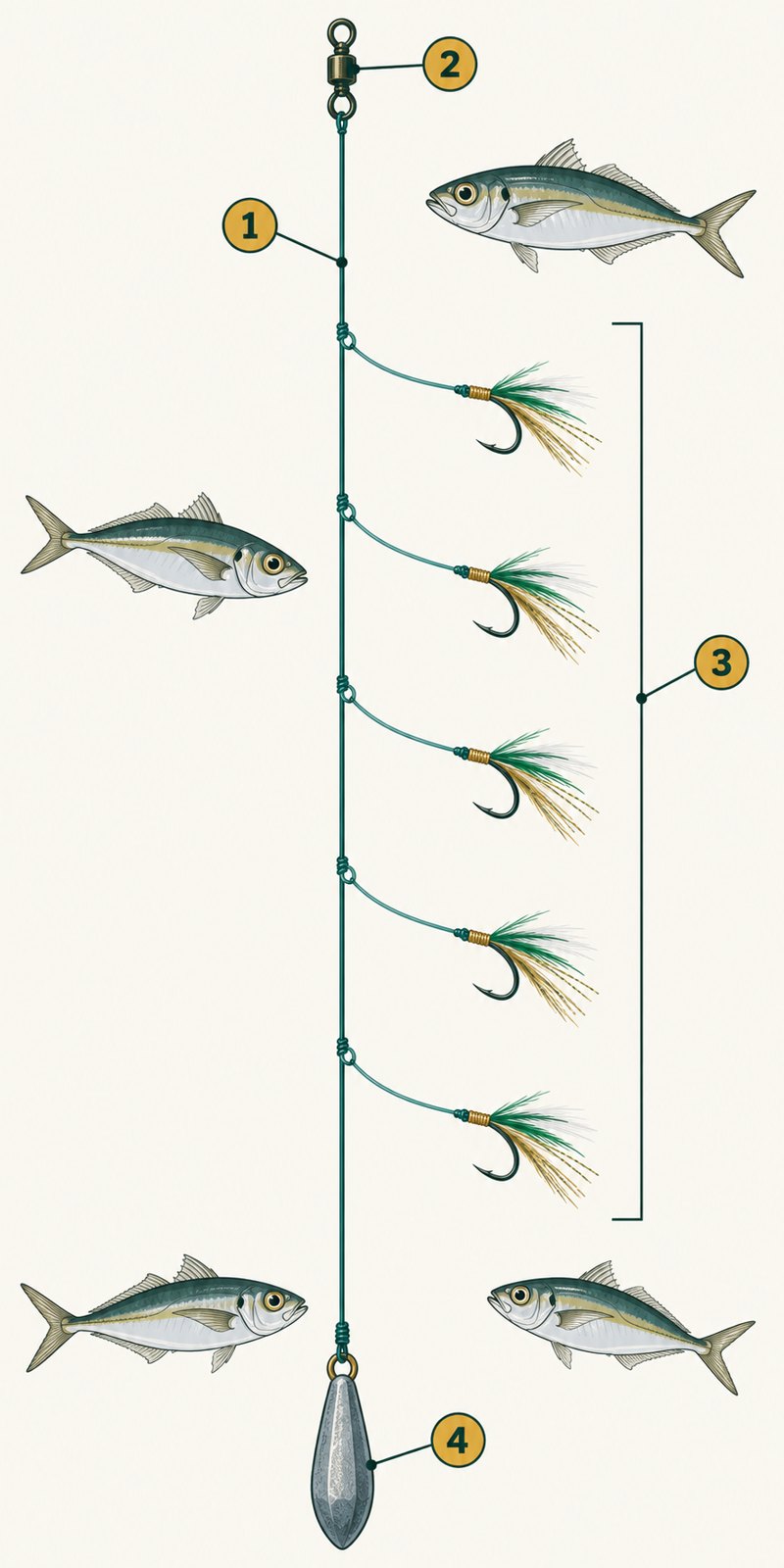
Light rod 2.10 to 2.70 m; braid PE 0.8 to PE 1.5 or nylon 0.20 to 0.25 mm; string of 4 to 6 hooks with feathers or shiny threads; sinker of 20 to 60 g at the end (species sheet 21).
The rig step by step
- tie the swivel at the top of the string
- tie the sinker at the end
- lower it into the school
- work it with short lifts
Bait: No bait: the feathers are enough. The horse mackerel caught then serve as live bait.
Setting and technique: Wind up slowly when several fish are hooked.
Casting with a steel trace
For : Guinean barracuda 25, West African Spanish mackerel 8, Wahoo 9, Mafou (Cobia) 28, Croupia roche (Tripletail) 49
A lure cast and retrieved; a steel trace protects the line from teeth.
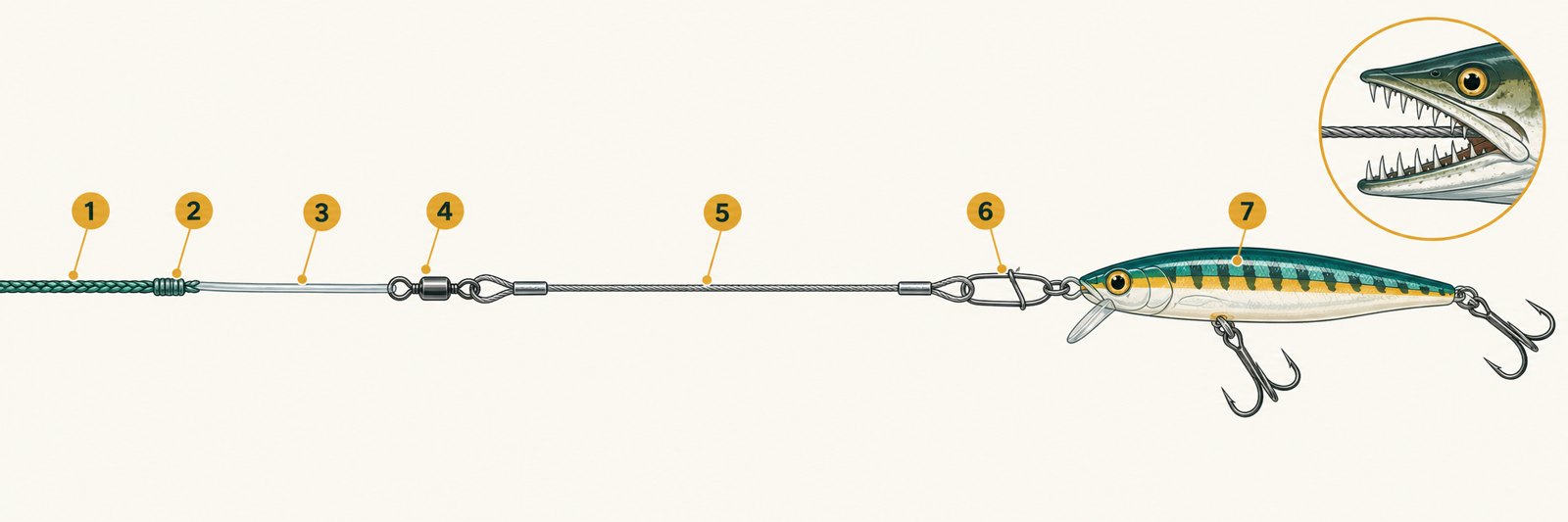
Spinning rod 2.40 m, 20 to 80 g; 4000 to 6000 reel; braid PE 2 to PE 4; fluorocarbon leader 40 to 60 lb; 7 x 7 wire trace of 30 to 50 lb, 30 to 40 cm; lure of 100 to 150 mm with reinforced trebles (species sheet 25).
The rig step by step
- join braid and fluorocarbon (Albright, or FG if you have mastered it)
- tie on the swivel
- attach the crimped steel trace to it
- clip on the lure
- set the drag before casting
Bait: Crankbait, soft plastic on a jig head, spoon.
Setting and technique: Vary speed and pauses until you find the retrieve of the day.
Coastal trolling
For : West African Spanish mackerel 8, Wahoo 9, Common dolphinfish 10, Guinean barracuda 25, Crevalle jack 16
Lures swim behind the boat at 4 to 6 knots; in an hour you cover what a caster explores in a day.
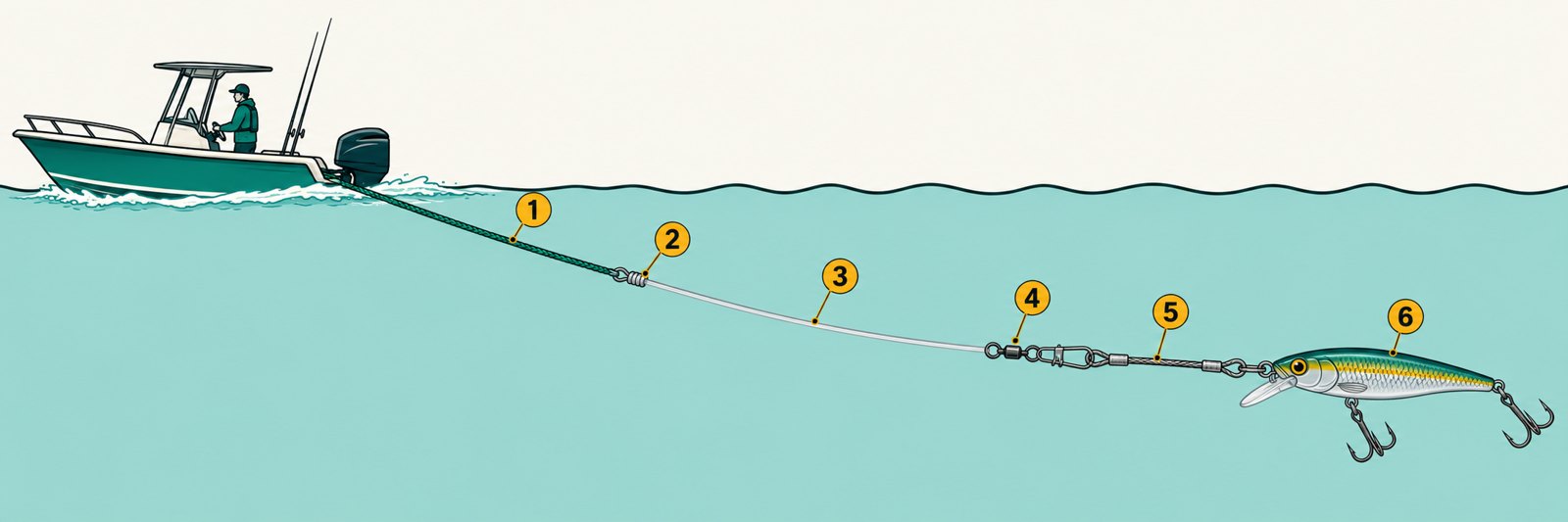
Outfits of 20 to 30 lb; fluorocarbon leader 80 to 100 lb; steel as soon as Spanish mackerels are about; diving crankbaits and spoons (V13, Part III, chapter 4). Spanish mackerel: 1.5 m leader, 30 cm wire trace, minnow 18 to 22 cm (species sheet 8).
The rig step by step
- rig each rod: braid, joining knot, fluorocarbon, snap swivel, steel, lure
- put the lures in the water one by one, checking their action
- stagger the distances to avoid tangles
- follow drop-offs, points, wrecks, changes in water colour
Bait: Lures: crankbaits, wobbling spoons, skirts.
Setting and technique: On the strike, the boat keeps going for a few seconds, then everything is cleared away.
Baits of the Ivorian coast
The best Ivorian bait comes from the beach, the lagoon or the market. For each one: where to find it, how to keep it, how to put it on the hook, and the fish whose species sheet mentions it.
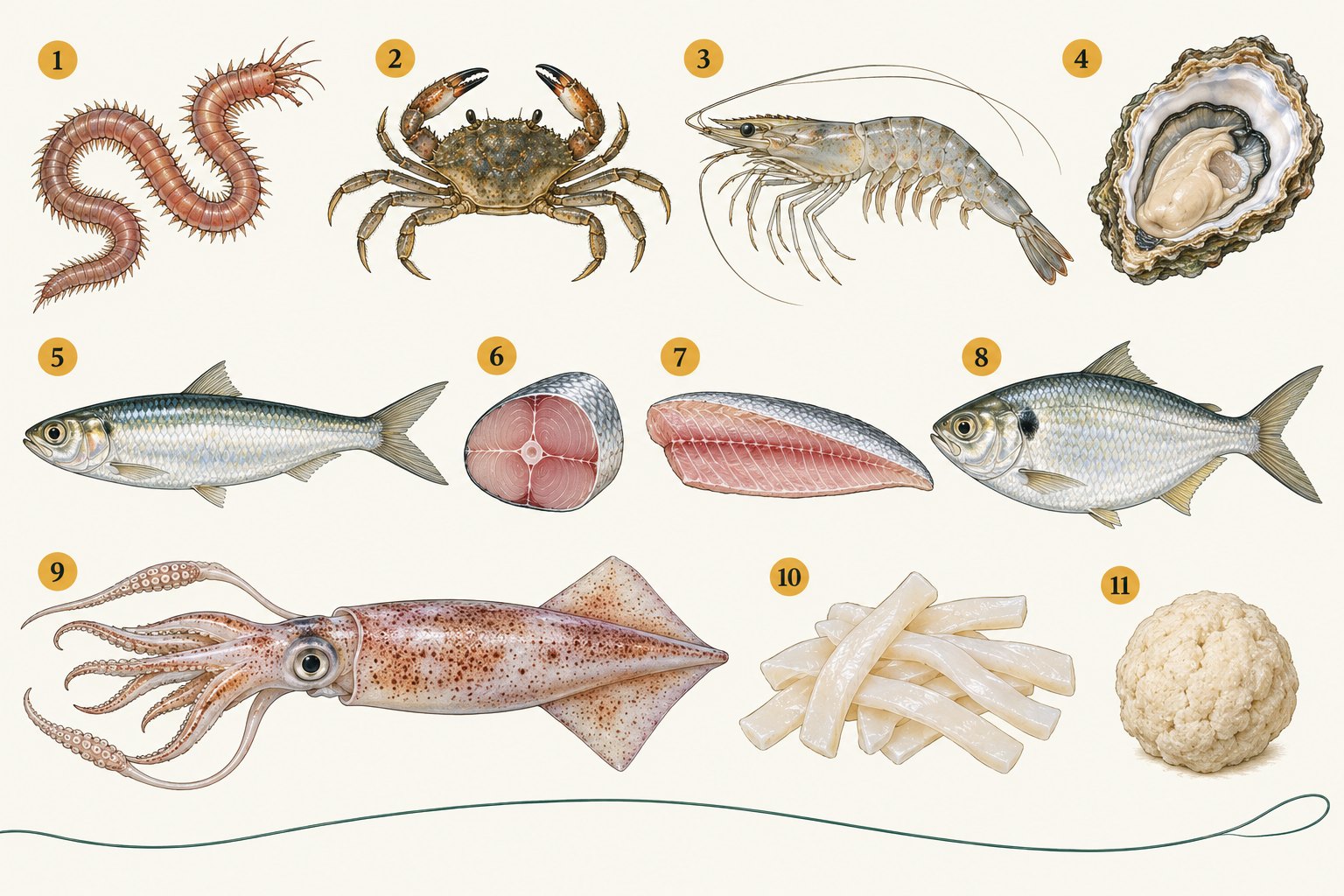
The marine worm
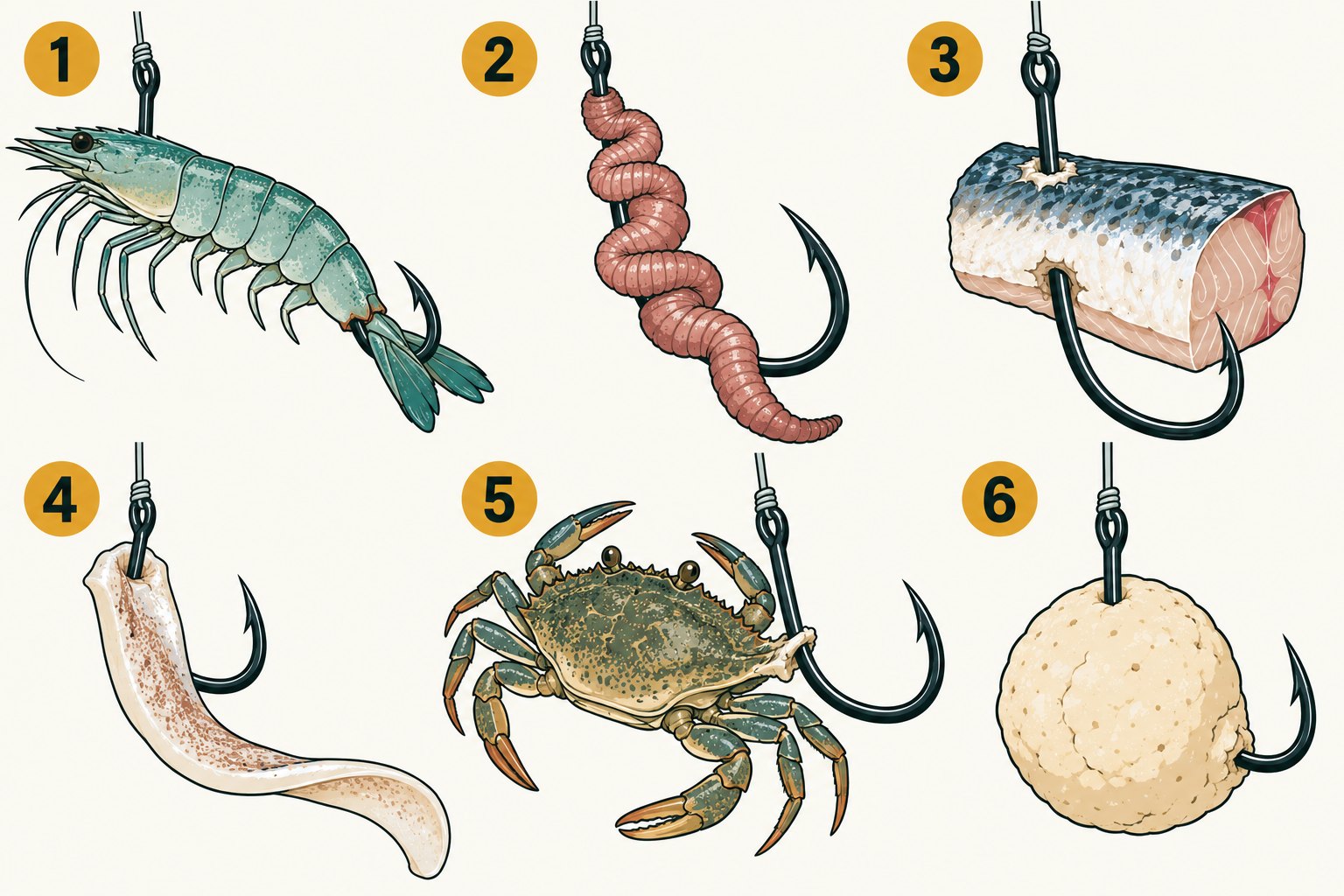
The universal surf bait, threaded accordion-style on a fine-wire hook.
- Where to find it: Sandy and muddy foreshores at low tide: spot the sand casts and dig fast.
- Choosing and keeping: Fragile: keep it cool, in the shade, in a little seawater or damp seaweed. Never in the sun.
- Baiting: see panel 2 of the “How to bait” diagram
- Rigs: Two-dropper surfcasting rig, Lagoon running ledger, The handline
- Species sheets citing it: 3
Crab
Tough on the cast, it stays on the hook and resists small bait-stealing fish.
- Where to find it: Beaches and mangrove, by hand at dusk.
- Choosing and keeping: Alive in a bucket of damp sand.
- Baiting: see panel 5 of the “How to bait” diagram
- Rigs: Two-dropper surfcasting rig, Lagoon running ledger
- Species sheets citing it: 5
Lagoon shrimp
Whole and live for good fish, peeled for small ones.
- Where to find it: Bought live from fishers or sieved along the edges.
- Choosing and keeping: Alive in an aerated bucket, or cool and out of the sun; peeled for finesse fishing.
- Baiting: see panel 1 of the “How to bait” diagram
- Rigs: Lagoon running ledger, The sliding float and fine line, The handline, Two-dropper surfcasting rig
- Species sheets citing it: 17
Mangrove oyster
Soft flesh to be secured well, sometimes with elastic thread; target species to be documented.
- Where to find it: Prised from the mangrove roots.
- Choosing and keeping: Use fresh, the same day.
- Rigs: Lagoon running ledger
- Species sheets citing it: 0
Sardinella
Whole as live or dead bait, in chunks for handlining, in fillets for the surf.
- Where to find it: Fish market or landing site, by the pile, in the morning.
- Choosing and keeping: Clear eyes, firm flesh; the cool box starts at the market. Salted leftovers: layer of coarse salt, airtight box, cool box, two more trips (V13).
- Baiting: see panel 3 of the “How to bait” diagram
- Rigs: The live bait rig, Heavy bottom rig for rocks, The handline, Two-dropper surfcasting rig
- Species sheets citing it: 13
Bonga shad
It replaces sardinella in the lagoon.
- Where to find it: Market, landing site, cast net in the lagoon.
- Choosing and keeping: Same as sardinella.
- Baiting: see panel 3 of the “How to bait” diagram
- Rigs: The live bait rig, Lagoon running ledger
- Species sheets citing it: 1
Squid
It stays on the hook like no other bait: strips for the bottom, heads for snappers.
- Where to find it: Fish market.
- Choosing and keeping: Cold; it keeps better than fish.
- Baiting: see panel 4 of the “How to bait” diagram
- Rigs: Heavy bottom rig for rocks, The handline
- Species sheets citing it: 13
Live bait
The king of baits for big predators.
- Where to find it: Caught yourself early in the morning, with a landing net or fine line (sabiki rig for horse mackerels).
- Choosing and keeping: Aerated live well or a bucket with frequently changed water.
- Rigs: The live bait rig
- Sheets citing it: 21
Dough and plant baits
For tilapias and mullets; hook point barely covered.
- Where to find it: Homemade: breadcrumb, semolina, flour.
- Choosing and keeping: In a damp cloth, in the shade.
- Baiting: see panel 6 of the “How to bait” diagram
- Rigs: The sliding float and fine line
- Species sheets citing it: 13
Sand eel
Bait to be confirmed in the field before the next edition.
- Where to find it: Cited in several species sheets; local availability to be documented.
- Choosing and keeping: To be documented.
- Rigs: Two-dropper surfcasting rig
- Species sheets citing it: 3
Groundbait and chum
Lagoon groundbaiting remains homemade and effective: shrimp scraps, crushed sardinella heads, wheat bran or oilseed cake from the market, mixed with mud from the spot. At sea, chum holds fish under the boat: ground sardinellas thrown in regular handfuls, never in bulk. The rule is the same everywhere: bait a little, bait often, and stop as soon as the fish are there.
- Sound the depth and choose the spot before groundbaiting.
- Throw a few balls or handfuls in the same place, not everywhere.
- Keep it going with small, regular amounts.
- Stop as soon as the bites start.
Which bait for which fish
This table is built from the text of the species sheets: for each bait, it lists the fish whose species sheet mentions it.
Troubleshooting at the water's edge
| What happens | What to do |
|---|---|
| The rig tangles on the cast | Droppers too long or too close together: shorten them, space the dropper loops further apart, cast with a wide, smooth motion. |
| The bait disappears without a bite | Small bait-stealing fish: switch to crab, squid or a tougher bait, or use a smaller hook to identify them. |
| The sinker rolls and comes back to shore | Sinker too light or unsuitable: switch to a grapnel sinker in the surf, go heavier in the current. |
| The leader is cut clean | Toothy fish: add a wire trace (barracudas, Spanish mackerels). |
| The fish comes off during the fight | Blunt hook or drag too tight: sharpen or change the hook, set the drag to a third of the line’s breaking strength. |
| The knot breaks | Knot tightened dry or damaged: always wet before tightening, test by hand before fishing, retie it after every big catch. |