
Large-scale silverside (group Brycinus)
Brycinus macrolepidotus Valenciennes, 1850
Family Alestidae • the silvery schooling characin, the “sardine” of the rivers
| French name | Large-scaled Brycinus, freshwater “sardine” |
|---|---|
| Scientific name | Brycinus macrolepidotus Valenciennes, 1850 |
| Family | Family Alestidae |
| English name (FAO) | Large-scale silverside (group Brycinus) |
| Local names | Freshwater “sardine”; local names to be documented |
| Habitat | Freshwater: rivers, reservoirs, floodplains; pelagic, schooling. |
| IUCN status | LC Least Concern. |
Identification
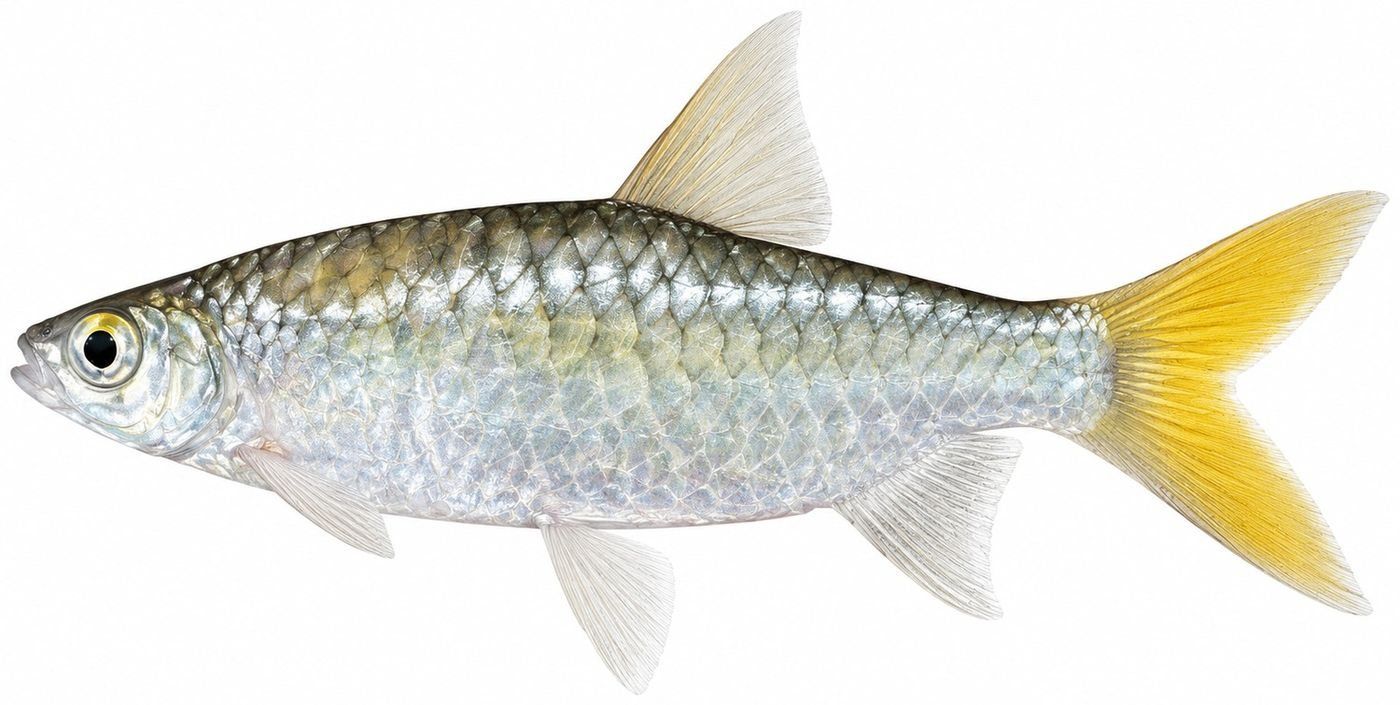
A characin with a compressed, bright silvery body, large clearly visible scales, greenish back, fins often slightly tinted. Small adipose fin at the rear; forked caudal. Looks like a freshwater “sardine”, living in active schools.
Features that never mislead
Silvery body with large, distinct scales (hence macrolepidotus).
Small adipose fin (characin family).
Forked caudal; swims fast in schools.
Modest mouth lined with small teeth.
Size and weight
Usually 12 to 25 cm; published maximum around 30 cm.
Behaviour and ecology
A gregarious, active fish of open water: it eats insects, seeds, plant debris and small invertebrates drifting in the current. Prime prey of the big predators (Nile perch, tigerfish), it plays a key role in the food chain.
Reproduction and season
Oviparous; spawns in the rainy season in flooded areas; numerous eggs ensure the renewal of the schools.
Fishing practice
Techniques, from most to least effective
Float fishing with a small bait (maggot, piece of worm, paste) over the schools. The top technique, ideal for beginners.
Fly or micro-lure on the surface when the schools are rising.
Cast net and small-mesh net in subsistence fishing.
Quick, lively bites; a lively little fish, great fun on light tackle. Easy and safe to handle.
Eating quality
A small fish with fine but bony flesh, mostly eaten fried whole or smoked; also makes an excellent live bait for predators.
Sources: FishBase (Brycinus macrolepidotus, Valenciennes 1850); IUCN Red List (Least Concern); Lévêque & Paugy. Related species: B. longipinnis, B. imberi. Local names to be documented.