
Denté à bosse (Pink dentex)
Dentex gibbosus (Rafinesque, 1810)
Family Sparidae • the large pinkish dentex with the humped forehead
3 look-alikes to know
| French name | Denté à bosse. Other names: denté rosé, denti à bosse, pink dentex. |
|---|---|
| Scientific name | Dentex gibbosus (Rafinesque, 1810) |
| Family | Family Sparidae |
| English name (FAO) | Denté à bosse (Pink dentex) |
| Local names | On Ivorian markets and landing sites: “Daurade” (Ouattara et al., 2016). |
| Habitat | Marine, benthopelagic. Depth 20 to 220 m, over rocky and stony bottoms and sand around rocks. |
| IUCN status | LC Least Concern. A high-value fish, targeted by commercial fishing. |
Identification
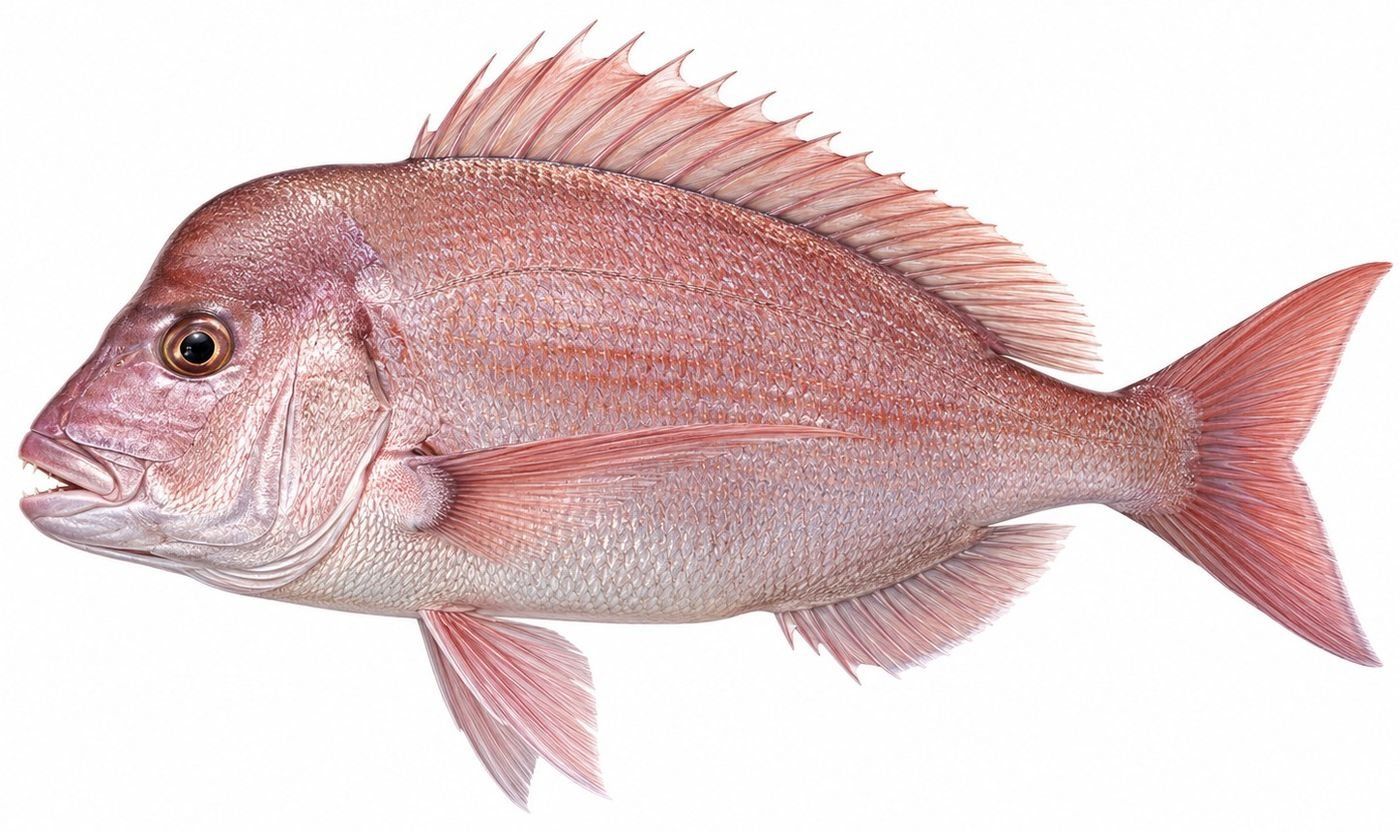
A large, robust sparid with a deep body, silvery pink, often tinged darker red in big fish. Large males develop a strong forehead hump and long filaments at the front of the dorsal fin, hence its former name Dentex filosus. Powerful head, jaws armed with strong canines. Dark spots on the head in males, grey in females.
Features that never mislead
Strong forehead hump in large males, very rounded profile.
Long filaments at the front of the dorsal fin in big fish.
Prominent canines at the front of the jaws, a predator’s profile.
Pinkish to dark red livery, spots on the head.
Size and weight
Common size around 60 cm. Published maximum length about 106 cm fork length, for a maximum weight of around 16.4 kg (FishBase). It is one of the largest sparids on the Ivorian coast.
Behaviour and ecology
A vigorous demersal predator of the hard bottoms of the shelf, hunting crustaceans, fish and cephalopods. Young fish stay coastal, large adults move to the edge of the continental slope.
Present in the Eastern Atlantic from Portugal to Angola, including the Mediterranean and the Atlantic islands. On the Ivorian coast, it is a bottom fish popular with rock fishers. IUCN status: Least Concern.
Reproduction and season
Protogynous hermaphrodite: maturity at around 35 cm, individuals starting as females before becoming males. Coastal spawning, pelagic eggs and larvae.
Fishing practice
Techniques, from most to least effective
Bottom fishing with natural bait (squid, sardine, crab) on drop-offs and rocky bottoms.
Deep handline fishing and heavy tataki.
Deep trolling and metal lures for active fish.
The fight: very powerful, with deep runs towards the rocks. You must hold it from the bite to stop it sawing the line on the stones.
Eating quality
White, firm and fine flesh, among the noblest of West African bottom fish. Excellent baked or as a grilled steak. Highly sought after, which supports its commercial value.
Sources: FishBase (Dentex gibbosus, Rafinesque 1810); IUCN Red List 2014 (LC, e.T170186A1289197); FAO Eastern Central Atlantic; Ouattara et al. 2016.