
Banded jewelfish
Hemichromis fasciatus Peters, 1857
Family Cichlidae • the small, scrappy five-spot predator
| French name | Banded hemichromis, “joker”. Other usage: poisson-rouge (not to be confused with the aquarium goldfish) |
|---|---|
| Scientific name | Hemichromis fasciatus Peters, 1857 |
| Family | Family Cichlidae |
| English name (FAO) | Banded jewelfish |
| Local names | Joker; local names to be documented |
| Habitat | Freshwater: ponds, rivers, weed beds, edges of floodplain lagoons; tolerates brackish water. |
| IUCN status | LC Least Concern. |
Identification
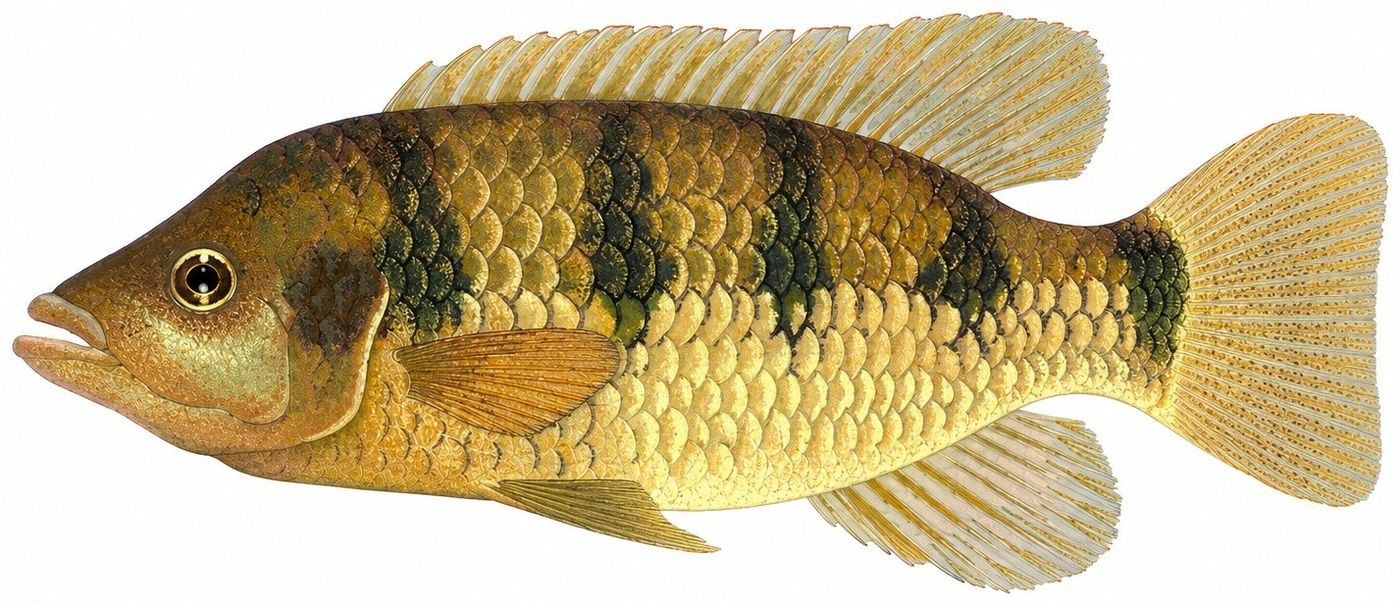
A stocky cichlid, yellow-olive to reddish, marked with five dark spots in a row along the flank (bars or dots depending on mood). Fins often speckled, turning bright in the breeding season. Wide predator's mouth.
Features that never mislead
Five dark spots in a row along the flank, the species' signature.
Stocky body, turning bright red in breeding fish.
Wide mouth of a small predator.
Single long dorsal fin, spiny at the front.
Size and weight
Usually 12 to 20 cm; published maximum around 25 cm.
Behaviour and ecology
An aggressive, territorial predator: it hunts fry, small fish, insects and crustaceans. A formidable guardian of its young, it stands up to much bigger fish. Common in calm, vegetated waters.
Reproduction and season
Substrate spawner with intense biparental care: the pair fiercely defends a territory, cleans a stone or pit, and escorts the fry in a tight school.
Fishing practice
Techniques, from most to least effective
Light line with a worm or small live bait near weed beds. The top technique.
Small soft lure imitating a fry.
Small-mesh net in subsistence fishing.
Lively and feisty for its size, it hits the bait hard and fights well. Easy to handle; watch out for the dorsal spines.
Eating quality
Decent flesh but a small fish, mostly eaten fried or included in mixed dishes of pond fish.
Sources: FishBase (Hemichromis fasciatus, Peters 1857); IUCN Red List (Least Concern); Lévêque & Paugy. Local names to be documented.