
Pageot à têche rouge (Red pandora)
Pagellus bellottii Steindachner, 1882
Family Sparidae • the pinkish pandora of coastal schools
3 look-alikes to know
| French name | Pageot. Other names: pageot rosé, pageot du Sénégal, red pandora. |
|---|---|
| Scientific name | Pagellus bellottii Steindachner, 1882 |
| Family | Family Sparidae |
| English name (FAO) | Pageot à têche rouge (Red pandora) |
| Local names | On Ivorian markets and landing sites: “Daurade” (Ouattara et al., 2016). |
| Habitat | Marine, demersal. Depth 1 to 250 m, over both hard and soft bottoms. A gregarious schooling species. |
| IUCN status | LC Least Concern. A common and abundant species, heavily exploited in West Africa. |
Identification
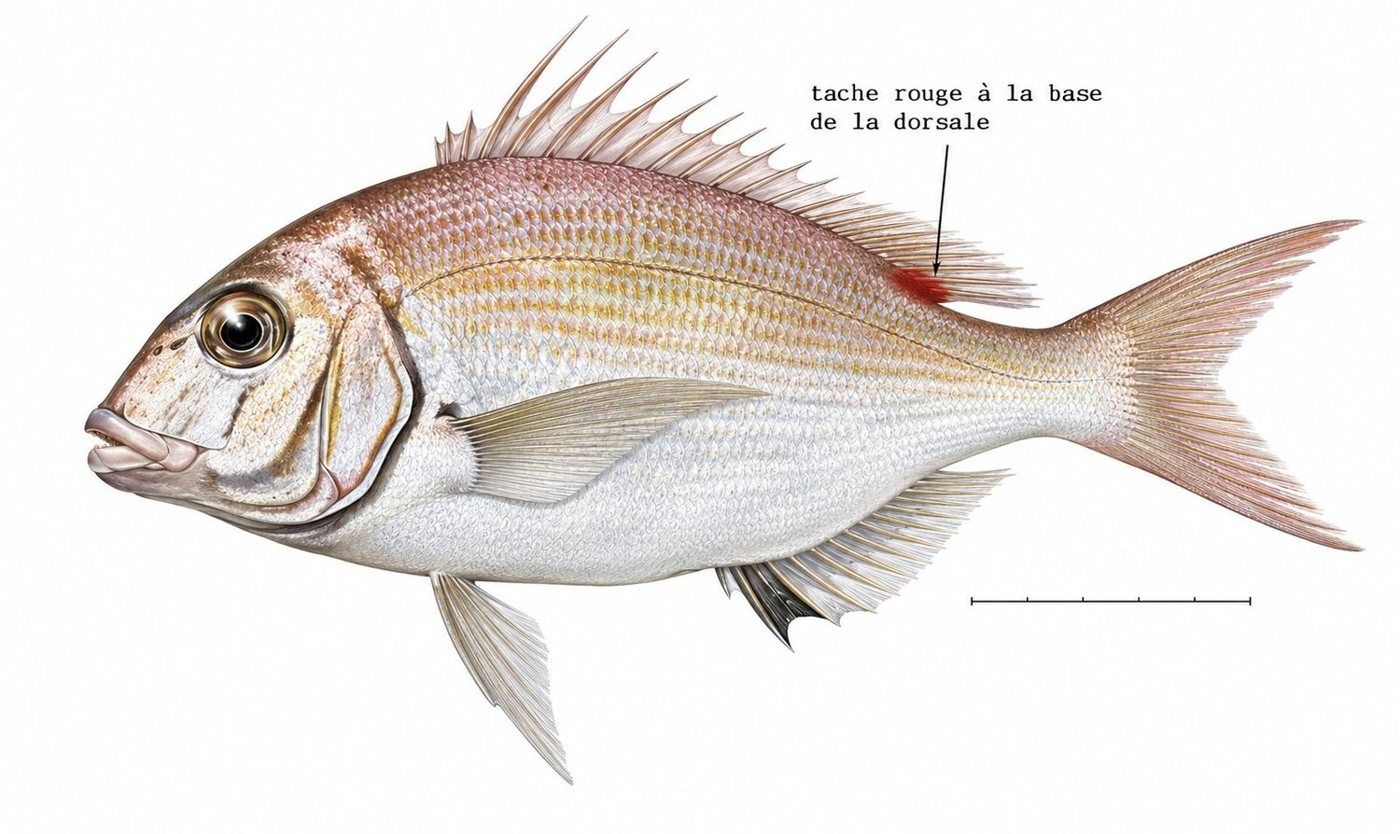
A small sparid with an oval, compressed body, pinkish to pale red on the back, silvery flanks. Fairly large eye. A small red or dark spot often marks the origin of the lateral line, directly above the pectoral armpit. Modest mouth, conical teeth at the front and molar-like teeth at the back.
Features that never mislead
Small red spot at the origin of the lateral line, near the pectoral fin.
Pinkish to pale red livery, silvery flanks.
Oval compressed body, profile of a small schooling sparid.
Mixed teeth: conical at the front, molar-like at the back.
Size and weight
Common size around 25 cm. Published maximum length about 42 cm (FishBase). On the Ivorian coast, most catches are around 20 to 30 cm.
Behaviour and ecology
A gregarious species that forms schools over hard and sandy bottoms on the shelf. Carnivorous: crustaceans, cephalopods, small fish and worms. Young fish stay near the coast.
Present in the Eastern Atlantic from Gibraltar and the Canary Islands to Angola, and in the Mediterranean, which it has entered recently. Very common on the Ivorian coast, a mainstay of coastal demersal fishing. IUCN status: Least Concern.
Reproduction and season
Protogynous hermaphrodite: early maturity at around 12 cm. Coastal spawning, pelagic eggs and larvae, over an extended season. High fecundity.
Fishing practice
Techniques, from most to least effective
Bottom fishing with natural bait (worm, shrimp, piece of fish).
With a baited multi-hook rig (sabiki type) over schools.
Caught in coastal trawls and nets.
The fight: lively on light line, with the quick vibrations typical of small sparids. It is mainly a fish for family bottom fishing and for the market.
Eating quality
Fine, tasty white flesh, much appreciated despite the small size. Excellent grilled or braised whole. Widely seen on Ivorian market stalls at an affordable price.
Sources: FishBase (Pagellus bellottii, Steindachner 1882); IUCN Red List, LC; FAO Eastern Central Atlantic; Ouattara et al. 2016.