
Petit capitaine (Lesser African threadfin)
Galeoides decadactylus (Bloch, 1795)
Family Polynemidae • the small ten-filament threadfin
1 look-alike to know
| French name | Petit capitaine. Other names: capitaine, barbure, petit threadfin. |
|---|---|
| Scientific name | Galeoides decadactylus (Bloch, 1795) |
| Family | Family Polynemidae |
| English name (FAO) | Petit capitaine (Lesser African threadfin) |
| Local names | On Ivorian markets and landing sites: “Capitaine” (Ouattara et al., 2016). |
| Habitat | Marine and brackish, demersal. Depth 10 to 70 m, over soft bottoms. Enters brackish waters. |
| IUCN status | NT Near Threatened. A species heavily exploited by West African coastal fisheries. |
Identification
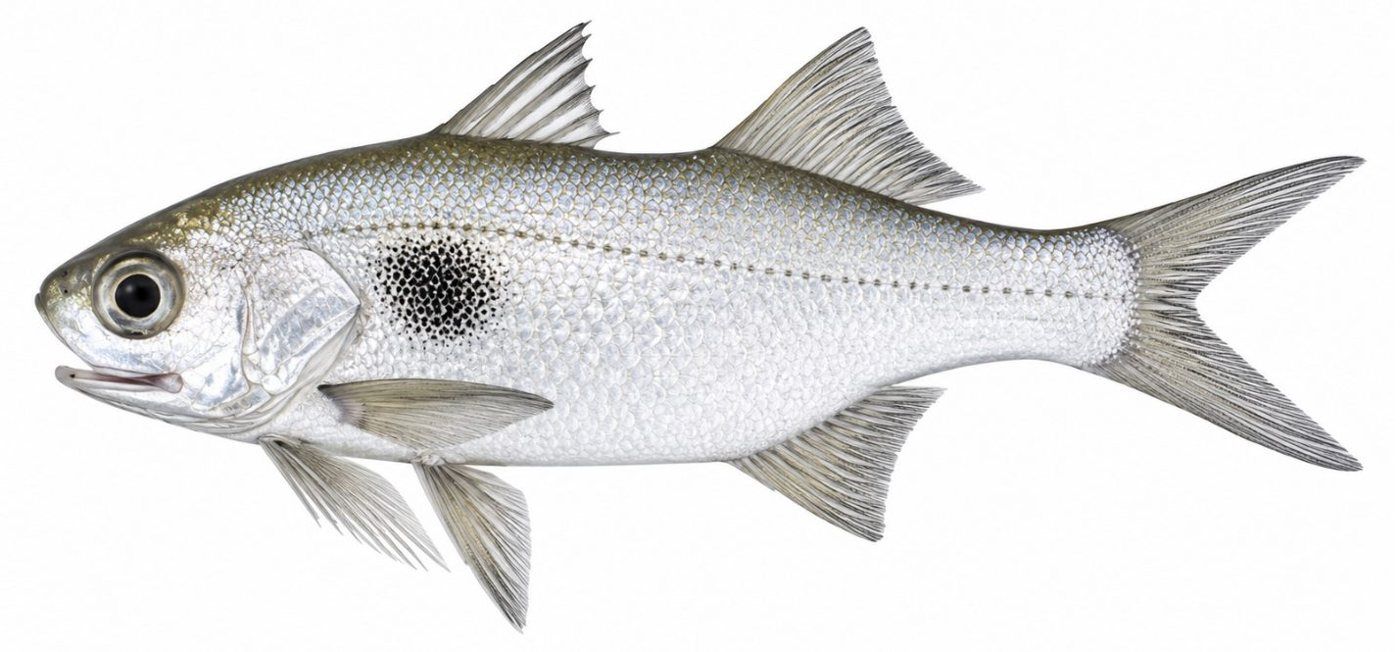
A small threadfin with an elongated, silvery body and a conical snout overhanging the inferior mouth, like its big cousin. It differs from it by its small size and by numerous fine free filaments below the pectoral fin, rather than four. Two separate dorsal fins. Forked tail.
Features that never mislead
Numerous fine filaments below the pectoral fin, not four as in the giant African threadfin.
Small size, elongated silvery body.
Conical snout overhanging the inferior mouth.
Two well-separated dorsal fins.
Size and weight
Common size around 30 cm. Published maximum length 50 cm total length (FishBase). Early maturity, at around 12 cm.
Behaviour and ecology
A gregarious species of coastal soft bottoms, which probes sand and mud with its sensory filaments to flush out shrimp and small invertebrates. Enters brackish waters.
Present from the Canary Islands and Morocco to Angola. On the Ivorian coast, it is a common coastal fish, caught in large quantities. IUCN status: Near Threatened, a sign of fishing pressure.
Reproduction and season
Coastal spawning, pelagic eggs and larvae. Early maturity gives it some resilience despite exploitation.
Fishing practice
Techniques, from most to least effective
By bottom fishing with fine bait (worm, shrimp) over coastal and estuary bottoms.
By light surfcasting from the beaches.
Caught in coastal trawls and nets.
The fight: lively but modest given its size. It is mainly a subsistence and market fish, caught in large numbers, and a good live bait for predators.
Eating quality
Fine white flesh, appreciated despite its small size, inheriting the reputation of the threadfins. Excellent fried, grilled or charcoal-grilled (braisé). Very common on Ivorian markets.
Sources: FishBase (Galeoides decadactylus, Bloch 1795); IUCN Red List (Near Threatened); FAO Eastern Central Atlantic; Ouattara et al. 2016.