
Crevalle jack
Caranx hippos (Linnaeus, 1766)
Family Carangidae • the queen of the Vridi battles
1 look-alike to know
| French name | Carangue crevalle. Other names: carangue, crevalle, “carangue jaune”. |
|---|---|
| Scientific name | Caranx hippos (Linnaeus, 1766) |
| Family | Family Carangidae |
| English name (FAO) | Crevalle jack |
| Local names | On Ivorian markets and landing sites: “Japon” (Ouattara et al., 2016). |
| Habitat | Marine, coastal and neritic pelagic, enters the canal and brackish waters. Depth 1 to 200 m. |
| IUCN status | LC Least Concern. West African coastal stock under heavy fishing pressure. |
How to recognise it
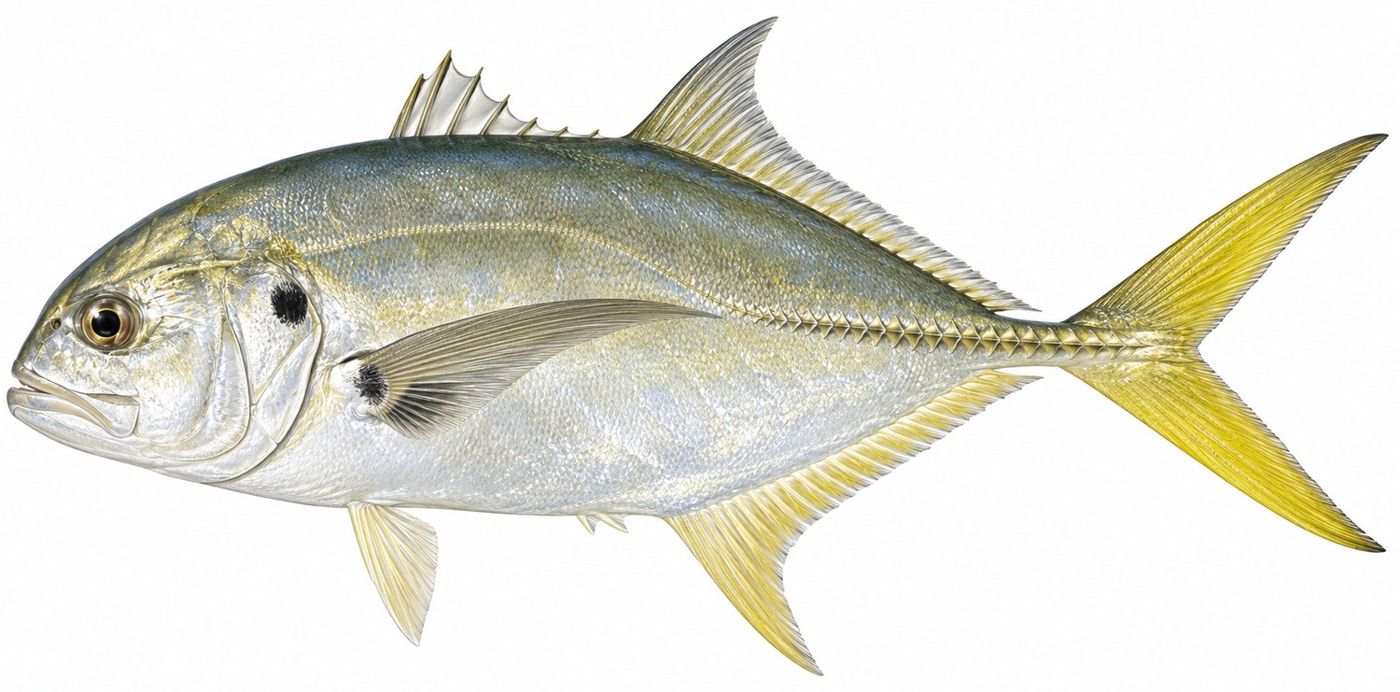
- large black spot on the edge of the gill cover, at eye level;
- black spot at the base of the pectoral fin, often a second one on its lower rays;
- keel of sharp scutes on the straight part of the lateral line, up to the tail: handle with a glove;
- breast scaleless, except for a small patch of scales in front of the pelvic fins (FishBase).
Deep, compressed body, with a steep, rounded forehead that becomes more pronounced with age. Green-blue to olive back, silvery to coppery flanks, pale belly, yellow tail and anal fin (FishBase).
The signs that never mislead:
Not to be confused with: the blue runner (Caranx crysos) has no black spot on the pectoral fin (feature to be confirmed on species sheet 17).
Size and weight
Common size 75 cm; published maximum 124 cm and 32 kg (FishBase). At Vridi, typical catches of 2 to 10 kg (V13, field knowledge). Maturity at about 66 cm (V13, source to be specified).
Life and season
A gregarious predator: schools drive sardinellas and anchovies to the surface in noisy feeding frenzies, the signal anglers watch for. At the Vridi canal, it lies in ambush at the canal mouth on the ebb and moves up the canal on the flood. Peak season from June to October, when the upwelling concentrates the baitfish.
Fishing
1. Poppers and stickbaits on feeding frenzies, from the jetties or by boat at the canal mouth.
2. Metal jigs when the fish are feeding deep.
3. Live bait (sardinella, small mackerel) at current spots, for large fish.
Fight: drag set tight at 8 to 12 kg, steady pressure; a thick glove to grab the tail.
At the table and precautions
Red, firm flesh, braised or in sauce; bleed as soon as it is caught. Caution: cases of ciguatera have been reported in very large fish in some tropical areas (source to be cited precisely); prefer medium sizes.
Sources: FishBase, Caranx hippos (accessed on 23/10/2026); species sheet 16 V13. IUCN status: Least Concern (assessment of 10/09/2018, IUCN Red List, via FishBase, checked on 23/10/2026).