
Tigerfish
Hydrocynus forskahlii (Cuvier, 1819)
Family Alestidae • the silver hunter with protruding fangs, a rocket in the current
| French name | Tigerfish, capitaine-tigre, hydrocyon |
|---|---|
| Scientific name | Hydrocynus forskahlii (Cuvier, 1819) |
| Family | Family Alestidae |
| English name (FAO) | Tigerfish |
| Local names | Tigerfish, capitaine-tigre; local names to be documented |
| Habitat | Freshwater: large flowing rivers, reservoirs, open channels. Pelagic. |
| IUCN status | LC Least Concern. |
Identification
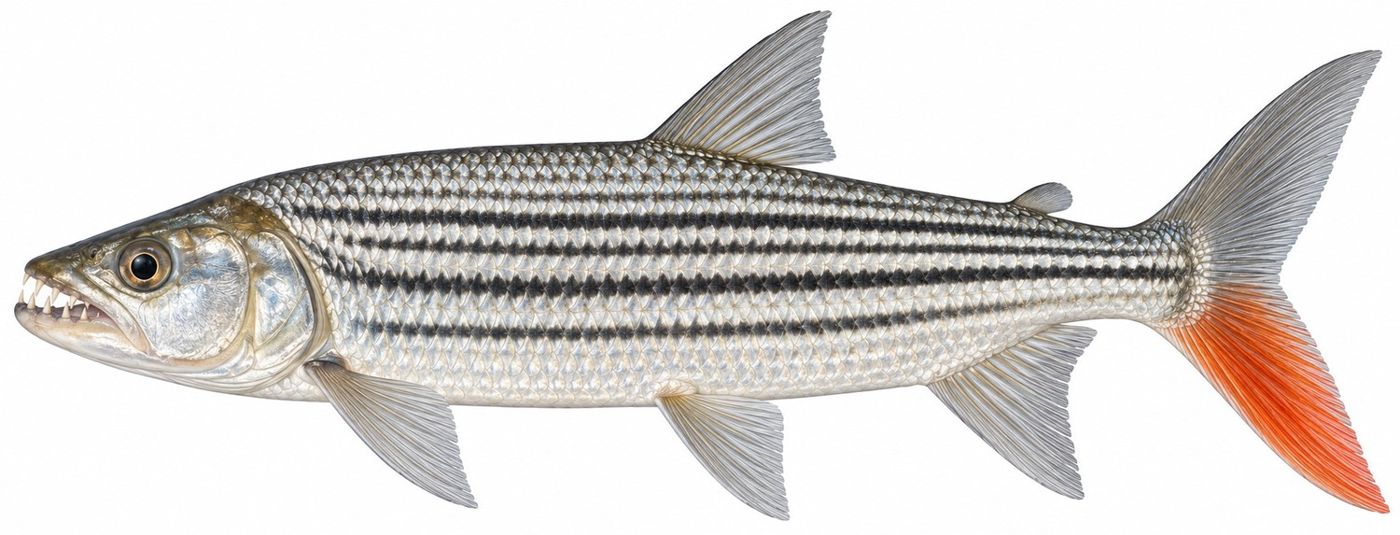
A streamlined, silvery fish with flanks marked by fine dark longitudinal lines, fins often tinged red-orange. Unmistakable signature: large, protruding conical teeth, visible with the mouth closed. Muscular body built for speed.
Features that never mislead
Large protruding conical teeth, sticking out past the lips.
Slender silvery body with fine longitudinal stripes.
Fins (especially caudal and anal) often edged with red or orange.
Adipose fin present; powerful forked tail.
Size and weight
Usually 30 to 60 cm; published maximum around 78 cm for several kilos (the giant relatives of Central Africa exceeding 50 kg do not occur in our basins).
Behaviour and ecology
A fast, voracious pelagic predator, hunting forage fish in schools in current seams. Excellent eyesight; lightning attacks. Seeks well-oxygenated, lively water.
Reproduction and season
Oviparous; spawns in the rainy, high-water season, often after moving into flooded areas.
Fishing practice
Techniques, from most to least effective
Fast lures (wobbling spoon, crankbait, blade bait) cast into the current. The top technique.
Live bait drifted in fast-water seams.
Light trolling on reservoirs.
A spectacular fight: violent strikes, jumps and fast runs; the tigerfish often throws the hook by shaking its head. An abrasion-resistant leader (or even fine wire) is essential because of the teeth. Always unhook with pliers, never put fingers near the mouth.
The current rig, piece by piece
- Spinning rod 2.10 to 2.40 m, 10 to 40 g
- Spinning reel size 3000 to 4000
- Main line: braid PE 1.5 to 2
- Fine steel trace, 20 to 30 cm
- Snap
- Wobbling spoon of 15 to 30 g, treble hook
- Variant: small diving plug
Eating quality
Decent white flesh but very bony, which limits its table value; it is mainly sought as a sport fish and, locally, smoked.
Sources: FishBase (Hydrocynus forskahlii, Cuvier 1819); IUCN Red List (Least Concern); Lévêque & Paugy. Local names to be documented. Illustrated rig (2026): indicative values from common sport-fishing practice (IGFA line classes, West African fishing-guide usage), to be confirmed with local anglers.