
Baliste cabri (Grey triggerfish)
Balistes capriscus Gmelin, 1789
Family Balistidae • the grey triggerfish with the dorsal trigger
1 look-alike to know
| French name | Baliste cabri. Other names: baliste gris, poisson caoutchouc, cochon de mer. |
|---|---|
| Scientific name | Balistes capriscus Gmelin, 1789 |
| Family | Family Balistidae |
| English name (FAO) | Baliste cabri (Grey triggerfish) |
| Local names | On Ivorian markets and landing sites: “Poisson caoutchouc” (Ouattara et al., 2016). |
| Habitat | Marine, associated with reefs and hard bottoms. Depth 0 to 100 m, most often 0 to 55 m. Bays, lagoons, rocky bottoms. |
| IUCN status | VU Vulnerable. A heavily exploited species, declining in several areas of the Atlantic. |
Identification
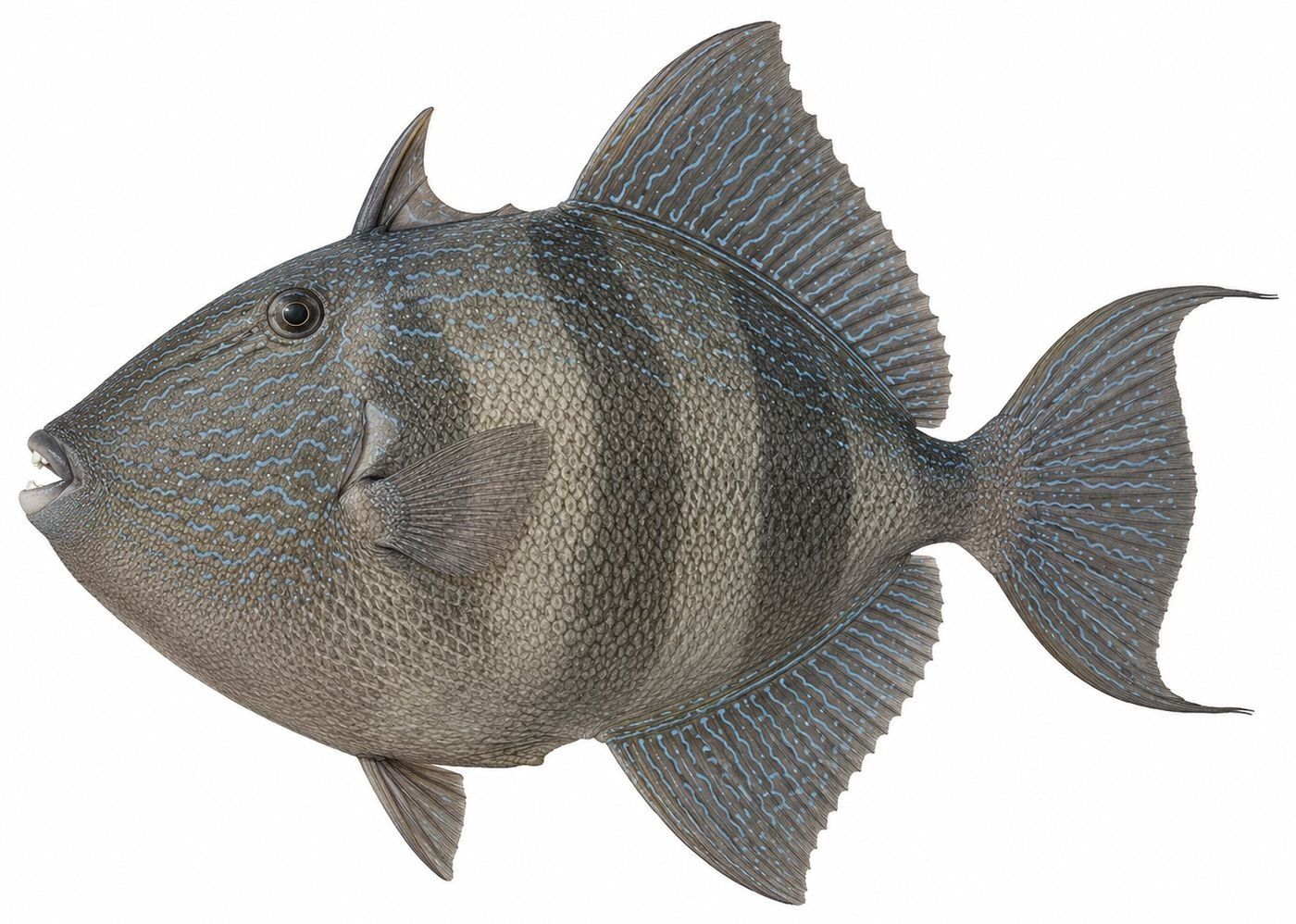
A fish with a deep, oval, strongly compressed body, greyish to brown, with thick, tough skin like leather. Small beak-like mouth with powerful teeth at the tip of the snout. Eye set high and far back. First dorsal fin with three spines, one of which is very strong and locks upright thanks to the second, a trigger mechanism.
Features that never mislead
Very strong first dorsal spine, locked upright by a trigger.
Thick, tough skin, deep and compressed body.
Small beak-like mouth with powerful teeth.
Small bluish spots on the upper body and the unpaired fins.
Size and weight
Common size around 44 cm. Published maximum length 66 cm total length, for a maximum weight of around 6.2 kg (FishBase). Maximum age about 15 years.
Behaviour and ecology
A predator of hard bottoms and reefs that crushes sea urchins, molluscs and crustaceans with its powerful teeth. It sometimes blows a jet of water to flip a sea urchin over and attack it from underneath.
Widely distributed in the Atlantic, on both sides, including the Mediterranean, down to Angola. Common over the hard bottoms of the Ivorian coast. IUCN status: Vulnerable, a sign of heavy fishing pressure.
Reproduction and season
Remarkable bottom nesting: the triggerfish digs a nest on the bottom, lays its eggs there, then actively guards and fans them. This nest defence makes it very vulnerable to capture during the breeding season.
Fishing practice
Techniques, from most to least effective
Bottom fishing with tough bait (squid, crab) over hard bottoms.
Handline fishing near reliefs.
Caught in coastal nets and traps.
The fight: surprisingly powerful for its size, the triggerfish braces itself and circles on the flat of its body. When bringing it aboard, watch out for the pinching beak and the raised dorsal spine.
Eating quality
White, firm and fine flesh, excellent once the thick skin is removed. Increasingly appreciated on the markets. Preparing it requires a sturdy knife.
Sources: FishBase (Balistes capriscus, Gmelin 1789); IUCN Red List (Vulnerable); FAO Eastern Central Atlantic; Ouattara et al. 2016.