
Blackchin tilapia
Sarotherodon melanotheron Rüppell, 1852
Family Cichlidae • the mouthbrooding tilapia of the Ébrié lagoon
2 look-alikes to know
| French name | Carpe lagunaire. Other names: tilapia de lagune, tilapia à menton noir. |
|---|---|
| Scientific name | Sarotherodon melanotheron Rüppell, 1852 |
| Family | Family Cichlidae |
| English name (FAO) | Blackchin tilapia |
| Local names | Commonly referred to by its usual French name on Ivorian markets and landing sites. Names in lagoon languages (Ébrié, Alladian, Avikam) are being collected in the field. |
| Habitat | Lagoon and brackish, euryhaline (fresh to hypersaline water). Abundant in mangroves. Depth 0 to 3 m. |
| IUCN status | LC Least Concern. West African coasts, from the lagoons of Mauritania to Cameroon. |
Identification
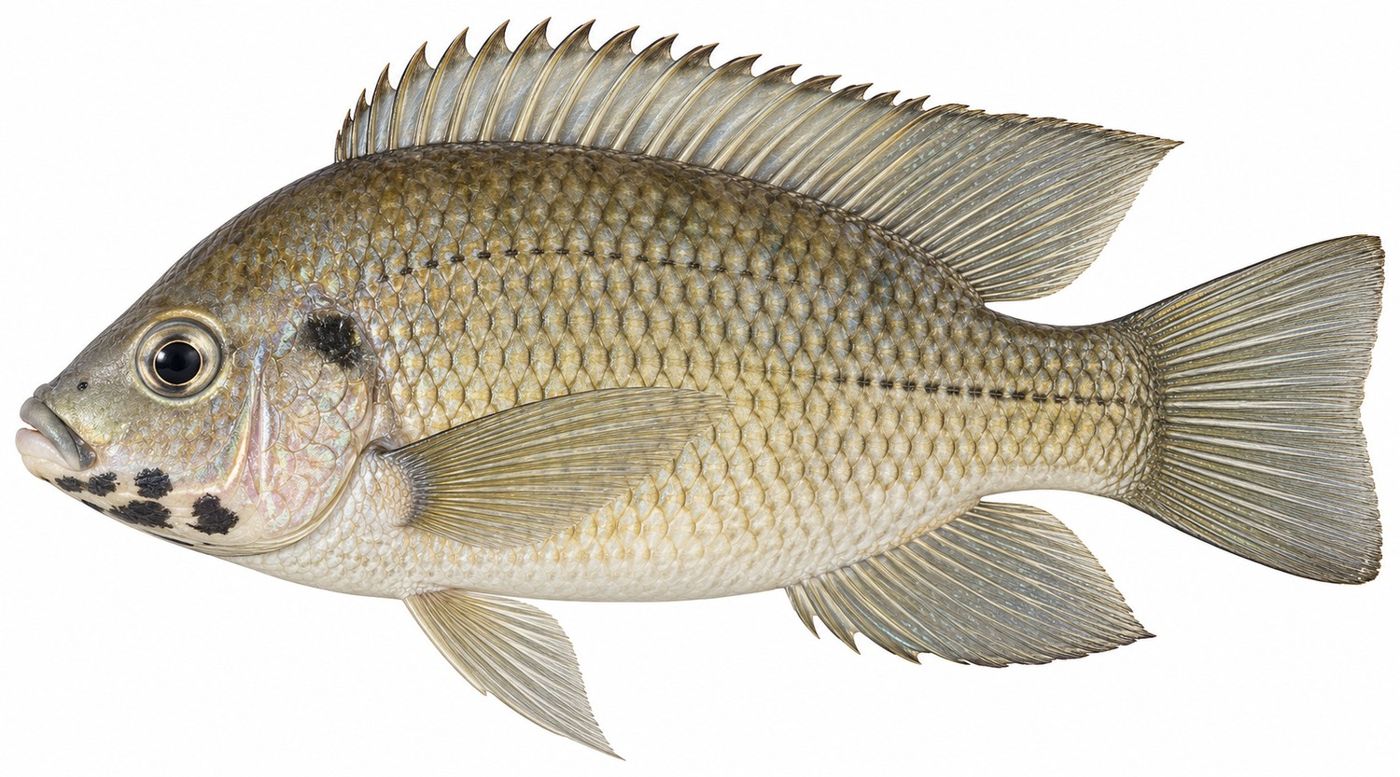
A cichlid with an oval, compressed body, back often golden to orange, lower body pale bluish. Typical dark (melanic) patches on the underside of the head, the throat and the chin, hence the name blackchin. A single long dorsal fin armed with many spiny rays.
Features that never mislead
- Dark patches on the underside of the head, the throat and the chin (the species’ signature).
- A single continuous dorsal fin with 15-17 spines, typical of cichlids.
- Oval compressed body, golden to orange back, bluish underside.
- Small size: rarely more than 25 to 28 cm.
Size and weight
Common size around 17 cm (TL). Published maximum length 28 cm (SL). Mature from about 12 cm. A small fish, but very abundant and heavily exploited.
Behaviour and ecology
A gregarious fish of shallow bottoms, mainly active at night. It feeds on aufwuchs (a film of algae and detritus), plankton and small invertebrates, taken in small bites. Remarkably tolerant of changes in salinity.
It is one of the most characteristic fishes of the Ébrié lagoon and the mangroves around Abidjan, a mainstay of subsistence fishing and lagoon aquaculture.
Reproduction and season
A remarkable mouthbrooder: it is the male that broods the eggs and fry in his mouth. The female initiates courtship and nest digging. Spawning in shallow water near the shore. This protective strategy supports dense populations.
Fishing practice
Techniques, from most to least effective
- With a fine float line and plant bait or paste, from a pirogue or the bank in the lagoon. The top technique.
- With cast nets and gillnets for subsistence fishing.
- In farming: production in pens and lagoon ponds.
A lively, nervous fight on fine tackle: the blackchin tilapia struggles with sharp jerks and pulls sideways. A family fish, ideal for learning to fish in the lagoon.
Eating quality
Prized white flesh, the basis of many lagoon dishes: charcoal-grilled (braisé), fried, in light sauce or in kedjenou. A popular, affordable fish on the Abidjan markets. Scale and gut quickly.
Did you know?
In the blackchin tilapia, it is the father who does the nurturing: the male keeps the eggs and then the fry safe in his mouth until they can face the lagoon. This paternal mouthbrooding, rare in the animal world, and its extraordinary tolerance of salt, from fresh water to lagoons saltier than the sea, make it a true survival champion of changing environments.
Sources: FishBase (Sarotherodon melanotheron, Rüppell 1852); IUCN Red List (Least Concern); Trewavas & Teugels 1991; CRO Abidjan / IRD studies on the Ébrié lagoon. Local names to be documented.