
Upside-down catfish (group)
Synodontis bastiani Daget, 1948
Family Mochokidae • the armoured catfish that swims on its back
| French name | Synodontis, upside-down catfish |
|---|---|
| Scientific name | Synodontis bastiani Daget, 1948 |
| Family | Family Mochokidae |
| English name (FAO) | Upside-down catfish (group) |
| Local names | Synodonte; local names to be documented |
| Habitat | Freshwater: rivers and streams with hard or soft bottoms, reservoirs; demersal. |
| IUCN status | LC Least Concern. |
Identification
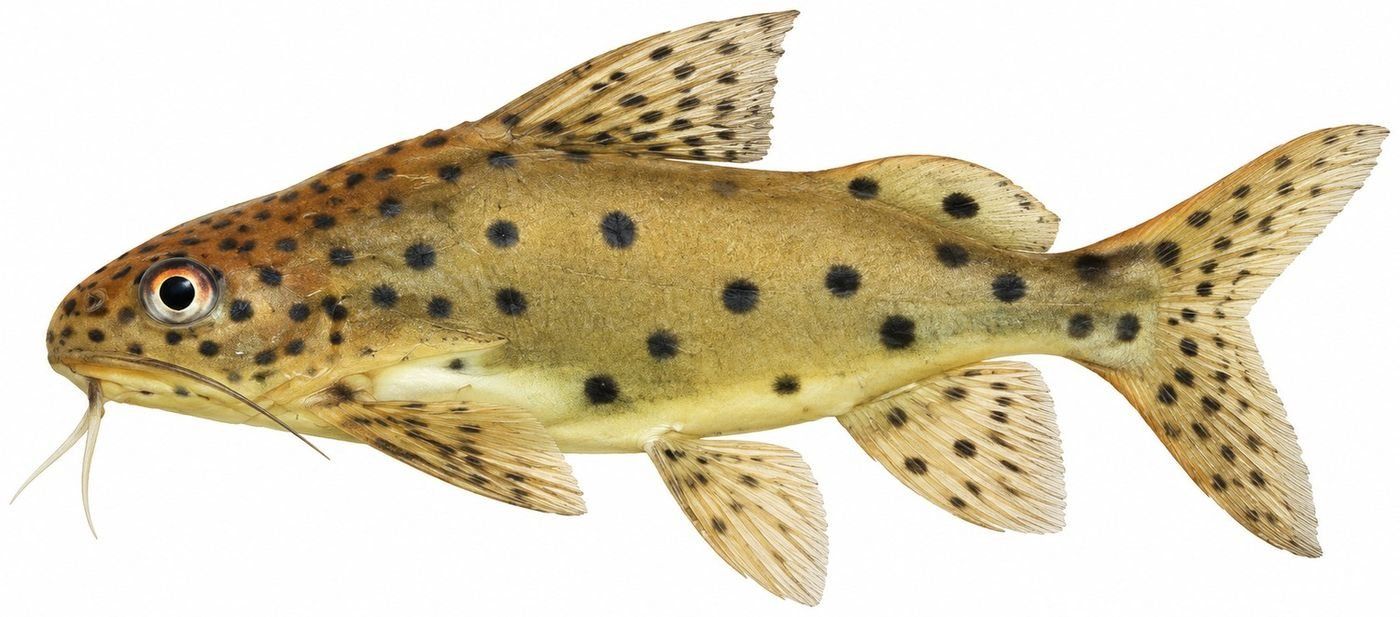
A stocky catfish with a naked body, grey to brown and often spotted, armoured bony head (shield), three pairs of barbels, the lower ones branched (feathery). Sturdy serrated spine in the dorsal and pectoral fins. Adipose fin present. Several closely related Synodontis occur in our basins.
Features that never mislead
Head armoured with a bony shield; short snout.
Three pairs of barbels, the chin barbels branched (feathery).
Strong serrated, locking spines in the dorsal and pectoral fins.
Sometimes swims upside down, belly up (behaviour typical of the genus).
Size and weight
Usually 12 to 25 cm depending on the species; some Synodontis exceed 30 cm.
Behaviour and ecology
A nocturnal omnivorous forager: larvae, worms, molluscs, algae and detritus scraped from the bottom. Gregarious, it stays under cover by day. The genus is famous for its ability to swim belly up to graze the surface film or the underside of objects.
Reproduction and season
Oviparous; spawns in the rainy season in flooded areas, often in groups. Detailed biology still poorly documented for some species.
Fishing practice
Techniques, from most to least effective
Light bottom line with worm or paste, near the bottom, at night. The top technique.
Trap set on the bottom.
Small-mesh net in subsistence fishing.
Positive bites and a lively fight from a small fish. Be extremely careful with the serrated spines, which lock and wound: unhook with pliers, without forcing, and never squeeze the fish in your hand.
Eating quality
Firm, tasty white flesh, much appreciated smoked; a small fish of great eating value, common on smoked-fish stalls.
Sources: FishBase (Synodontis bastiani, Daget 1948); IUCN Red List (Least Concern); Lévêque & Paugy. Related species: S. schall, S. punctifer. Local names to be documented.