
Requin-marteau halicorne (Scalloped hammerhead)
Sphyrna lewini (Griffith & Smith, 1834)
Family Sphyrnidae • the scalloped hammerhead, critically endangered
1 look-alike to know
| French name | Requin-marteau halicorne. Other names: requin-marteau festonné, marteau. |
|---|---|
| Scientific name | Sphyrna lewini (Griffith & Smith, 1834) |
| Family | Family Sphyrnidae |
| English name (FAO) | Requin-marteau halicorne (Scalloped hammerhead) |
| Local names | On Ivorian markets and landing sites: “Requin-marteau” (Ouattara et al., 2016). |
| Habitat | Marine, semi-oceanic. Continental margins, coasts and islands of tropical waters. The young in coastal nurseries. |
| IUCN status | EN Endangered. CITES Appendix II. One to three million individuals killed each year worldwide. |
Identification
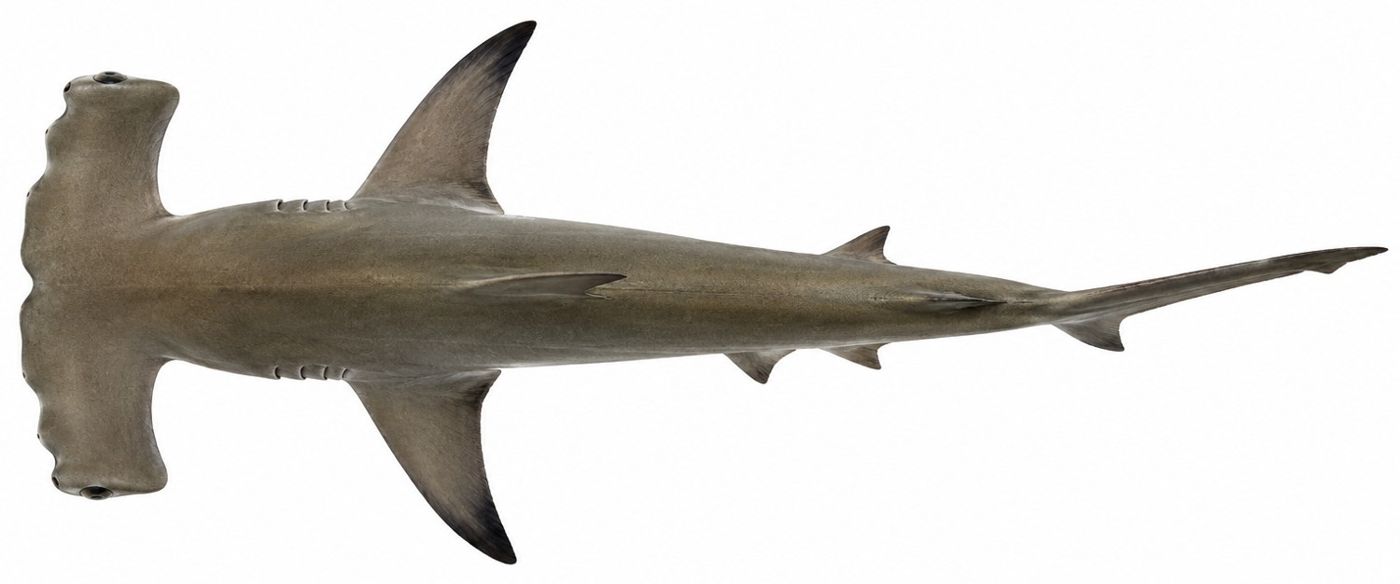
A shark instantly recognisable by its hammer-shaped head, widened sideways into two lobes, whose front edge is scalloped with a central notch and several indentations, hence the name scalloped. Body grey-bronze above, pale below. The eyes and nostrils are set at the ends of the hammer, which widens its sensory field.
Features that never mislead
Hammer-shaped head with a scalloped front edge (central notch and indentations).
Eyes and nostrils at the ends of the hammer, wider sensory field.
Body grey-bronze above, pale below.
Unmistakable hammerhead outline.
Size and weight
A large shark that can reach several metres. Precise maximum size and weight to be confirmed on FishBase. Late maturity and long lifespan.
Behaviour and ecology
A semi-oceanic shark that travels along continental margins following geomagnetic orientation, sometimes in large schools. Females show fidelity to their coastal nursery. Hunts fish, cephalopods and rays. Placental viviparity.
Present in all warm waters of the globe. Frequents Ivorian coastal and offshore waters, the young in coastal areas. IUCN status CRITICALLY ENDANGERED.
Reproduction and season
Placental viviparity, late maturity, long gestation, widely spaced litters. Females return to give birth in specific coastal nurseries. This very slow biology explains the collapse of populations under fishing pressure.
Fishing practice
Techniques, from most to least effective
Caught with longlines and nets, as a target or as bycatch, mainly for its fins.
A critically endangered species protected by CITES: targeted capture must be avoided.
Any live individual must be released with the greatest care.
The fight: powerful, but it should not be sought: faced with a critically endangered species protected by CITES, the only responsible course is to avoid capture and release any live fish, without taking it out of the water if possible.
Eating quality
Not applicable from a responsible standpoint: although the meat is eaten and the fins highly sought after, the critically endangered status and CITES protection mean this species must not be exploited. Its value is ecological, not commercial.
Sources: FishBase (Sphyrna lewini, Griffith & Smith 1834); IUCN Red List (Critically Endangered); CITES Appendix II; FAO Eastern Central Atlantic; Ouattara et al. 2016.