
Requin bleu (Blue shark)
Prionace glauca (Linnaeus, 1758)
Family Carcharhinidae • the elegant blue-backed oceanic shark
2 look-alikes to know
| French name | Requin bleu. Other names: peau bleue, requin bleu commun. |
|---|---|
| Scientific name | Prionace glauca (Linnaeus, 1758) |
| Family | Family Carcharhinidae |
| English name (FAO) | Requin bleu (Blue shark) |
| Local names | On Ivorian markets and landing sites: “Requin” (Ouattara et al., 2016). |
| Habitat | Marine, oceanic pelagic and offshore coastal. A great migrant of offshore waters, sometimes near the coast. |
| IUCN status | NT Near Threatened. One of the most heavily fished sharks in the world, mainly for its fins. |
Identification
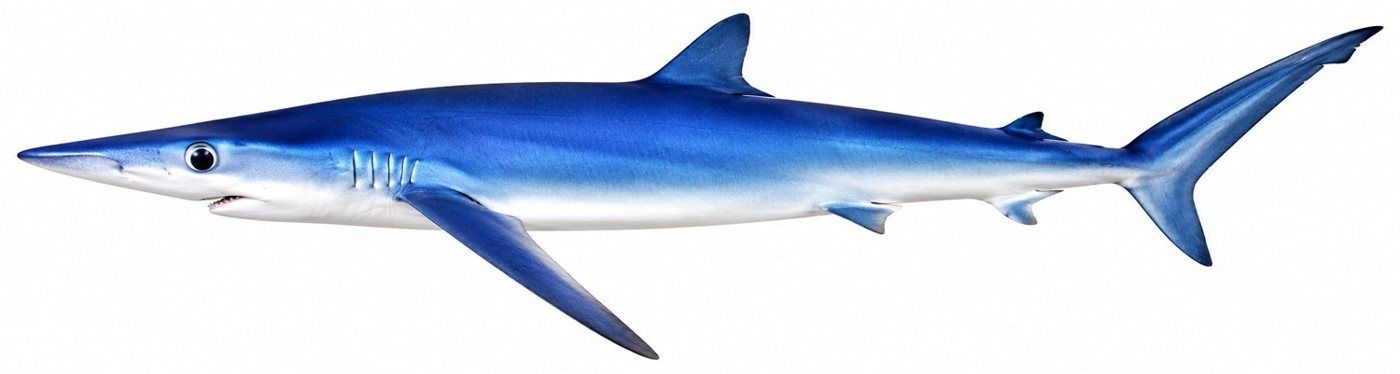
A slender, graceful shark with a spindle-shaped body, deep indigo blue on the back, lighter blue on the flanks, pure white below. Long, pointed snout, large round eyes. Very long, sickle-shaped pectoral fins that give it the outline of a glider. Heterocercal tail with an elongated upper lobe.
Features that never mislead
Deep indigo blue back, lighter flanks, white belly.
Very long falcate pectoral fins, glider-like outline.
Long, pointed snout, large round eyes.
Slender body, elegant look of an oceanic shark.
Size and weight
A large shark that can reach several metres. Precise maximum size and weight to be confirmed on FishBase. It is a slender rather than massive shark.
Behaviour and ecology
A great oceanic migrant that covers huge distances in open water, hunting squid and pelagic fish. Often curious, it approaches boats. Placental viviparity, litters sometimes large.
Present in all temperate and tropical oceans. Frequents waters offshore of the Ivorian coast. IUCN status: Near Threatened, because of massive fishing.
Reproduction and season
Viviparous with a yolk-sac placenta, long gestation, litters that can be large for a shark. Relatively late maturity. Despite higher fecundity than other sharks, global pressure exceeds renewal.
Fishing practice
Techniques, from most to least effective
Caught mainly offshore with pelagic longlines and by trolling, as a target or as bycatch of tuna fishing.
Rarely within reach from the shore, an offshore species.
A sensitive species: favour release.
The fight: long and powerful, made of runs and dives, it is a renowned big-game opponent. But its status calls for careful release rather than capture for its fins alone.
Eating quality
The meat is eaten in several countries, but most of the pressure comes from the fin trade, the main driver of global overfishing of blue sharks.
Sources: FishBase (Prionace glauca, Linnaeus 1758); IUCN Red List (Near Threatened); FAO Eastern Central Atlantic; Ouattara et al. 2016.