
Rainbow runner
Elagatis bipinnulata (Quoy & Gaimard, 1825)
Family Carangidae, subfamily Naucratinae • the tropical lightning bolt of the open sea
3 look-alikes to know
| French name | Coureur arc-en-ciel. Other names: saumon hawaïen, élagate. |
|---|---|
| Scientific name | Elagatis bipinnulata (Quoy & Gaimard, 1825) |
| Family | Family Carangidae, subfamily Naucratinae |
| English name (FAO) | Rainbow runner (ASFIS code: RRU) |
| Local names | On Ivorian markets and landing sites: “Banane” (Ouattara et al., 2016). |
| Habitat | Marine, pelagic and reef-associated, depth 0 to 150 m, usually 2 to 10 m. Ivorian coast to Angola. |
| IUCN status | LC Least Concern. An abundant pelagic species, sensitive to local pressure around FADs and drifting structures. |
Identification
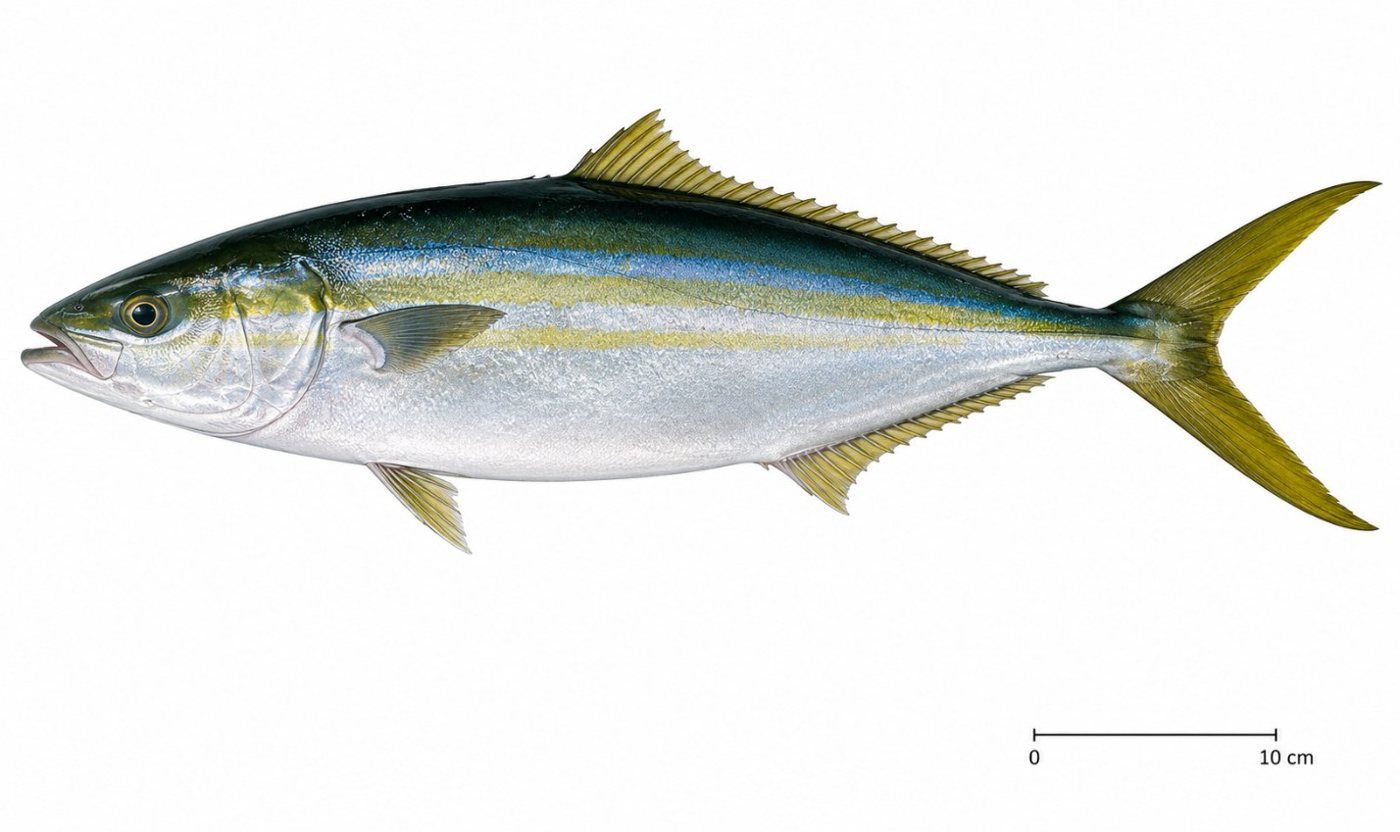
Elongated, fusiform and streamlined body, pointed snout, a sleek profile built for fast swimming. Blue-olive to greenish back, whitish belly. Its vivid colouring is unique among the Carangidae of the Gulf of Guinea: two bright blue longitudinal stripes run from the snout to the base of the tail, separated by a broad olive or yellow band.
The four features that never mislead:
- Two bright blue longitudinal stripes on the flanks, separated by a broad olive or yellow band (the species’ unmistakable visual signature).
- Two short detached finlets behind the second dorsal and anal fins (a feature shared with tunas and Spanish mackerels, but combined here with the blue and yellow livery).
- Deeply forked tail with pointed lobes, elongated and pointed snout.
- Slender caudal peduncle but without sharp scutes (a major difference from the true jacks of the genus Caranx).
Size and weight
Common size around 80 cm. Published maximum length 180 cm TL for the largest specimens, with a usual catch size of 60 to 90 cm. Maturity reached at about 64.6 cm (Lm). On the Ivorian coast, typical catches weigh 3 to 8 kg, with exceptional fish over 15 kg reported offshore around FADs.
Behaviour and ecology
A gregarious pelagic predator, closely associated with drifting structures (logs, palm fronds, FADs) and reef edges. It readily forms mixed schools with tunas, sailfish and other Carangidae offshore. Opportunistic diet: small fish, cephalopods and a wide range of planktonic crustaceans, which it hunts at the surface or in mid-water.
Off Côte d’Ivoire, the rainbow runner is one of the species most regularly caught around FADs set beyond the continental shelf. Its loyalty to floating structures also makes it an excellent indicator of the presence of tunas.
Reproduction and season
Spawns in open water, from spring to early autumn in the northern hemisphere, with a summer peak. Tropical populations breed all year round. Fishing season off the Ivorian coast: practically continuous, with a peak of activity from June to October, in step with the Guinean upwelling season.
Fishing practice
Techniques, from most to least effective
1. By light trolling over FADs and around floating objects, with 15 to 20 cm diving minnows or skirted jet heads. Trolling speed 6 to 8 knots, ideal along the edges of schools spotted by the birds.
2. By popping and stickbaiting when schools are feeding at the surface, given away by terns and brown boobies. Cast into the heart of the frenzy, with a fast, erratic retrieve.
3. With light 80 to 150 g jigs when schools drop to mid-water around structures, especially on the outer slopes of the shelf and around wrecks.
The fight is explosive from the strike: powerful sideways runs, short but repeated surges, and a characteristic attempt to dive under the boat as it tires. Set the drag at about a third of the braid’s breaking strain and work the fish with short pumps. Fish of 5 to 10 kg come in calmly; very large specimens (> 15 kg) call for a harness and good reel control.
Eating quality
Firm flesh, white to slightly pinkish, lean, with a fine, delicate taste. Often compared to amberjack, it is remarkably well suited to raw dishes (sashimi, ceviche, tartare), charcoal grilling and cooking en papillote. In Abidjan and along the coast it is enjoyed as braised fish with attiéké. Eat soon after capture, as the flesh deteriorates quickly in the tropical climate: bleed immediately and put on ice.
Did you know?
The rainbow runner is one of the most widely distributed marine fish in the world: it is found in all tropical and subtropical seas of the globe, from the Atlantic to the Indo-Pacific. It is also the only species in the genus Elagatis, a monotypic genus created in 1840 by Frederick Debell Bennett, after the species was first described in 1825 by Quoy and Gaimard as a close relative of the amberjacks. Its loyalty to drifting structures also makes it a valuable indicator species for locating tunas offshore.
Sources: FishBase (Elagatis bipinnulata, Froese & Pauly, 2025); FAO Fisheries, species RRU; IUCN Red List; Reef Life Survey; sport fishing observations from the Gulf of Guinea. Figures to be reconfirmed for Ivorian waters with the CRO Abidjan.