
Sole-lune africaine (African moony)
Monodactylus sebae (Cuvier, 1829)
Family Monodactylidae • the diamond-shaped moonfish of brackish waters
2 look-alikes to know
| French name | Sole-lune africaine. Other names: Saint-Pierre, poisson-lune africain, méné. |
|---|---|
| Scientific name | Monodactylus sebae (Cuvier, 1829) |
| Family | Family Monodactylidae |
| English name (FAO) | Sole-lune africaine (African moony) |
| Local names | On Ivorian markets and landing sites: “Saint-Pierre” (Ouattara et al., 2016). |
| Habitat | Marine, brackish and freshwater, coastal and estuarine. Highly euryhaline, frequents river mouths and mangroves. |
| IUCN status | NE Not Evaluated / to be checked. A species caught locally, also collected for the aquarium trade. |
Identification
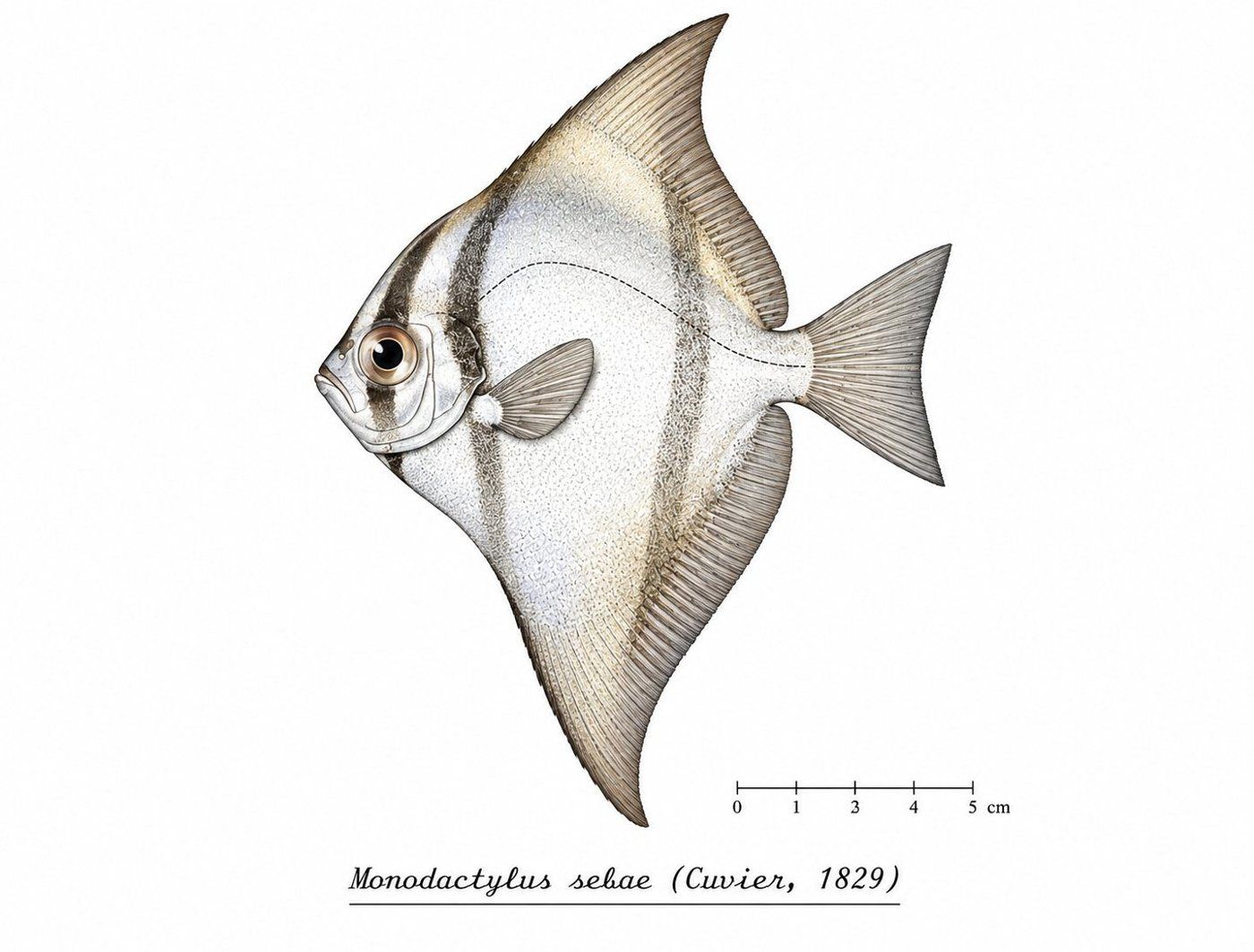
A small fish with a very deep, compressed body shaped like a diamond or a kite, bright silver. The tall, pointed dorsal and anal fins extend the diamond shape of the body. Often two to three dark vertical bars on the head and body, more marked in the young. Small mouth.
Features that never mislead
Very deep, compressed body shaped like a diamond or a kite.
Tall, pointed dorsal and anal fins extending the body.
Two to three dark vertical bars, marked in the young.
Bright silver coloration, small mouth.
Size and weight
A small fish, usual catches of about ten to twenty centimetres. Precise maximum size to be confirmed on FishBase.
Behaviour and ecology
A highly euryhaline, gregarious species that forms schools in coastal waters, estuaries and even fresh water, often near mangroves. Feeds on small invertebrates and detritus.
Present on the West African coast. In Côte d'Ivoire, frequents the Ébrié lagoon and river mouths. IUCN status to be checked.
Reproduction and season
Spawning in brackish to coastal waters, with the young using estuaries and mangroves as nurseries. Local spawning data to be documented.
Fishing practice
Techniques, from most to least effective
In small-scale fishing with fine bait in brackish waters.
Caught in fine-mesh lagoon nets.
Also collected for the aquarium trade, outside subsistence fishing.
The fight: modest given its small size, but nervous thanks to its flat body. Mainly a schooling fish caught in nets, and a fine sight to observe in brackish water.
Eating quality
Fine but small flesh, eaten locally fried or sold in lots. Its main value remains as food and, for fine specimens, as an ornamental fish.
Sources: FishBase (Monodactylus sebae, Cuvier 1829); FAO Eastern Central Atlantic; Ouattara et al. 2016; IUCN status to be reconfirmed.