
Grondin volant (Flying gurnard)
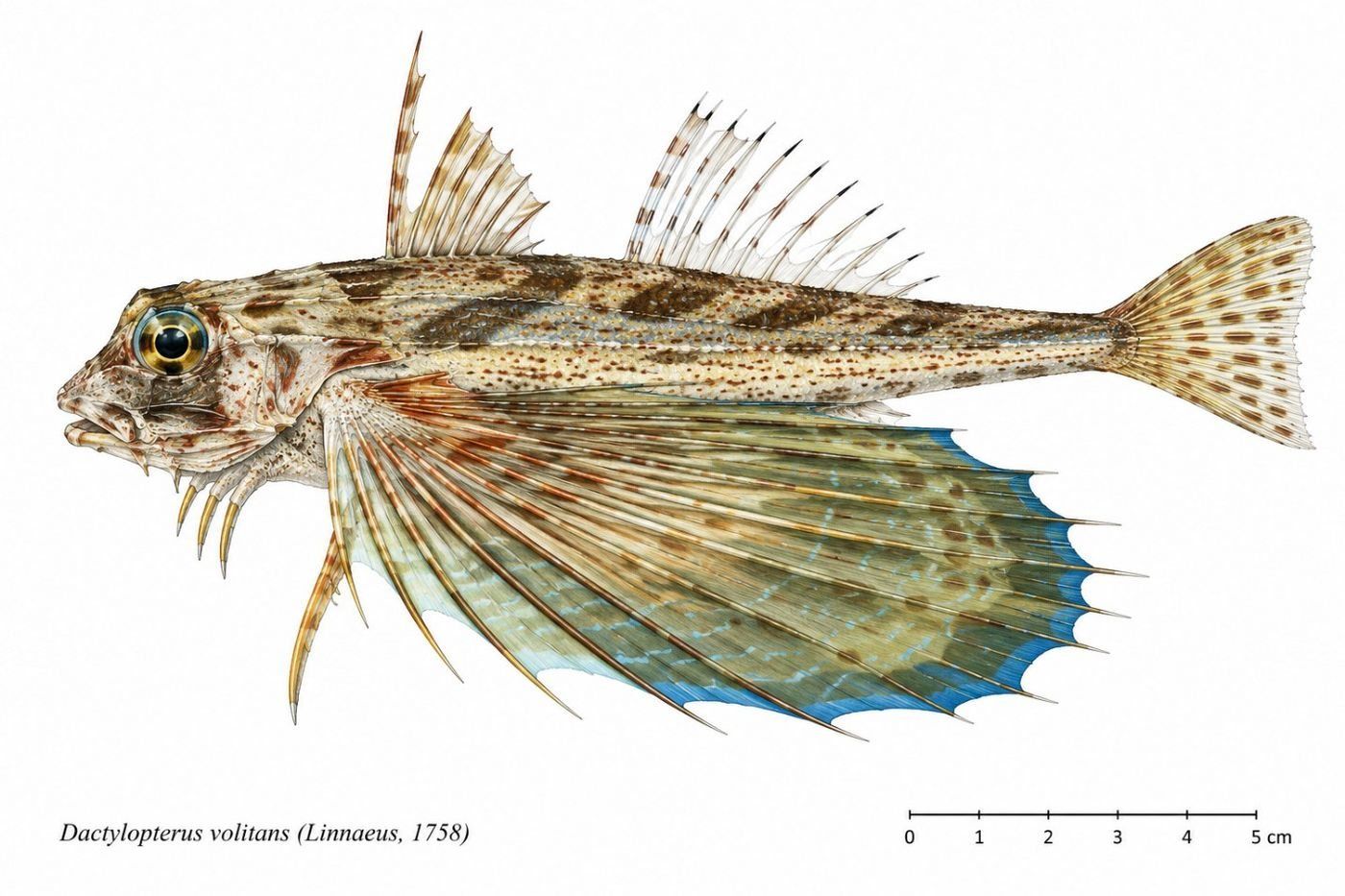
Dactylopterus volitans (Linnaeus, 1758)
Family Dactylopteridae • the bottom-dwelling ‘flying fish’ with outspread wings
1 look-alike to know
| French name | Grondin volant. Other names: poisson-volant, gallinette, hirondelle de mer. |
|---|---|
| Scientific name | Dactylopterus volitans (Linnaeus, 1758) |
| Family | Family Dactylopteridae |
| English name (FAO) | Grondin volant (Flying gurnard) |
| Local names | On Ivorian markets and landing sites: “Poisson-volant” (Ouattara et al., 2016). |
| Habitat | Marine, demersal on coastal sandy and muddy bottoms. Walks on the bottom using its fins. |
| IUCN status | LC Least Concern. A widely distributed species, caught incidentally. |
Identification
A fish with an elongated body and a broad, armoured head, brownish with reflections. A spectacular feature: huge wing-shaped pectoral fins, which it spreads into a colourful fan edged with bright blue, to impress or to glide near the bottom. The first pectoral rays, separate from the rest, are used to “walk” on the sand.
Features that never mislead
Huge wing-shaped pectoral fins, spread into a colourful fan edged with blue.
Broad head armoured with bone.
First pectoral rays separate, used for walking on the bottom.
Elongated brownish body with reflections.
Size and weight
A medium-sized fish, typical catches of a few decimetres. Precise maximum size to be confirmed on FishBase.
Behaviour and ecology
A species of sandy and muddy bottoms that moves slowly, “walking” on its free pectoral rays to search the sand for crustaceans and small invertebrates. Spreads its wings to frighten a predator.
Widely distributed in the Atlantic, including the Mediterranean. Present on Ivorian coastal grounds. IUCN status: Least Concern.
Reproduction and season
Coastal spawning, pelagic eggs and larvae. Local spawning data to be documented.
Fishing practice
Techniques, from most to least effective
As bycatch in coastal trawls and nets over soft bottoms.
Bottom fishing with bait.
Rarely targeted specifically.
The fight: modest, but the fish makes an impression as soon as it is brought up, spreading its colourful wings. Mainly a spectacular bycatch.
Eating quality
Decent white flesh but not much of it, given the large bony head. Eaten locally, mainly in soup. Modest commercial value.
Sources: FishBase (Dactylopterus volitans, Linnaeus 1758); IUCN Red List, LC; FAO Eastern Central Atlantic; Ouattara et al. 2016.