
Saint-Pierre (John Dory)
Zeus faber Linnaeus, 1758
Family Zeidae • the John Dory with the legendary round spot
1 look-alike to know
| French name | Saint-Pierre. Other names: poule de mer, dorée, Saint-Pierre vrai. |
|---|---|
| Scientific name | Zeus faber Linnaeus, 1758 |
| Family | Family Zeidae |
| English name (FAO) | Saint-Pierre (John Dory) |
| Local names | On Ivorian markets and landing sites: “Yawal” (Ouattara et al., 2016). |
| Habitat | Marine, coastal and deep demersal on the shelf and slope. Often in cooler, deeper waters. |
| IUCN status | DD Data Deficient. A popular food fish, stock poorly documented. |
Identification
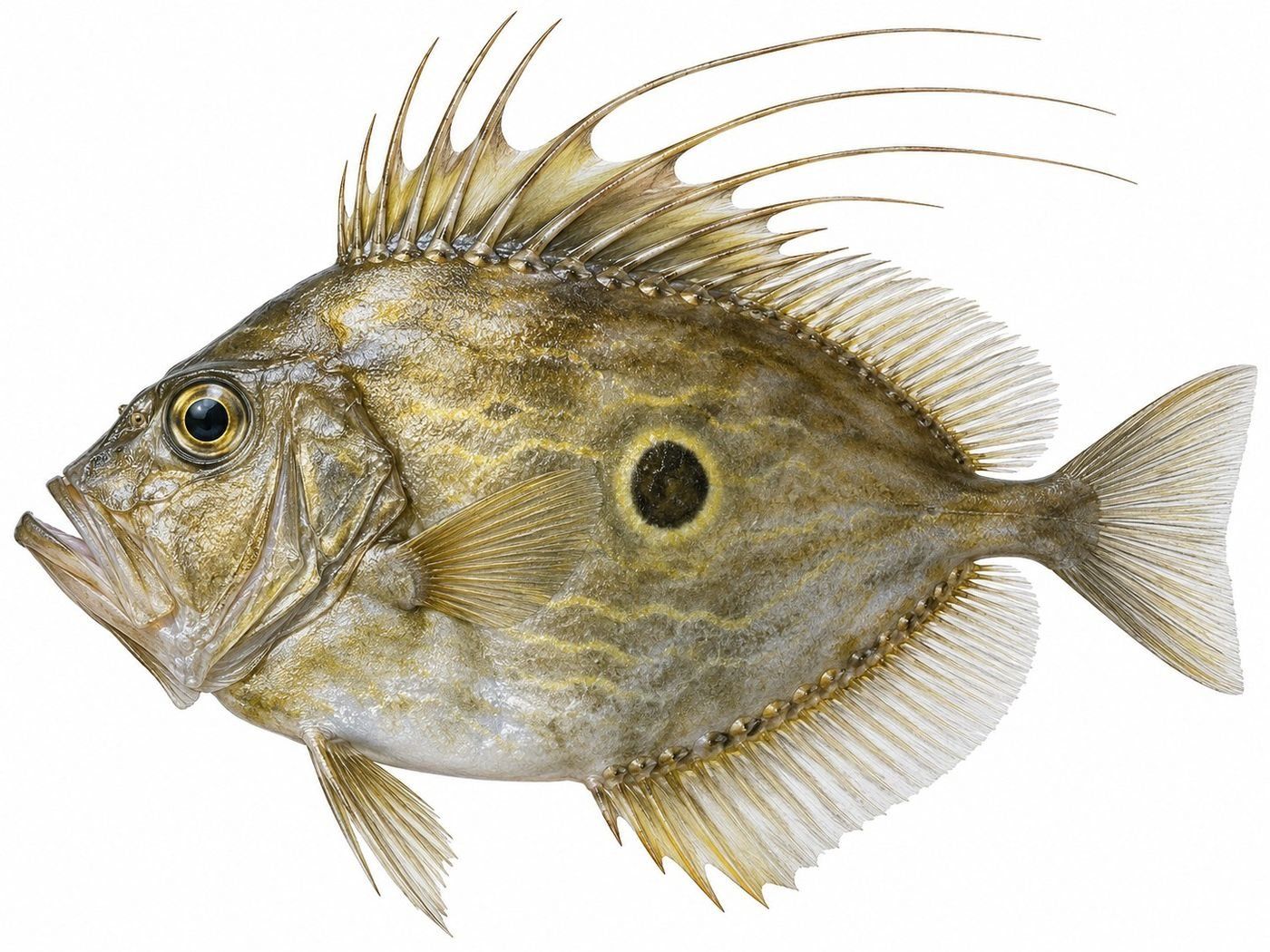
A fish with an oval, very deep and strongly compressed body, olive to yellowish. An unmistakable mark: a large round black spot, ringed with pale, in the middle of each flank. Long dorsal spines extended into filaments. Large eyes at the front of the head, highly protrusible mouth able to shoot forward to suck in prey.
Features that never mislead
Large round black spot ringed with pale in the middle of each flank.
Long dorsal spines extended into filaments.
Oval, very deep and compressed body, olive to yellowish.
Highly protrusible mouth, shot forward to suck in prey.
Size and weight
A fish that can reach several decimetres, up to about 60 to 90 cm depending on the population. Precise size for the Ivorian coast to be confirmed on FishBase.
Behaviour and ecology
A slow, solitary predator of coastal and deep grounds. It approaches its prey head-on, thanks to its body being thin when seen from the front, then shoots out its mouth to suck it in at once. Hunts small fish and cephalopods.
Widely distributed in the Eastern Atlantic, the Mediterranean and beyond. Present on the Ivorian shelf, mainly in deeper, cooler waters. IUCN status: Data Deficient.
Reproduction and season
Spawns in open water, pelagic eggs and larvae. Local spawning data to be documented. Moderate growth.
Fishing practice
Techniques, from most to least effective
Bottom fishing with natural bait (small fish, live bait) over the shelf grounds.
Deep handline and tataki fishing.
Caught in deep demersal trawls.
The fight: not very spectacular, the John Dory puts up a feeble defence; its appeal lies elsewhere: it is an exceptional delicacy. The strike must be firm because its hard mouth holds the hook poorly.
Eating quality
White, firm flesh of great delicacy, among the noblest there is. Much sought after as fillets, baked or pan-fried. High gastronomic value.
Sources: FishBase (Zeus faber, Linnaeus 1758); IUCN Red List 2015 (Data Deficient, e.T198769A42390771); FAO Eastern Central Atlantic; Ouattara et al. 2016.