
Atlantic bumper
Chloroscombrus chrysurus (Linnaeus, 1766)
Family Carangidae • the curved-bellied “plat-plat” of murky waters
| French name | Sapater. |
|---|---|
| Scientific name | Chloroscombrus chrysurus (Linnaeus, 1766) |
| Family | Family Carangidae |
| English name (FAO) | Atlantic bumper |
| Local names | On Ivorian markets and landing sites: “Plat-plat” (Ouattara et al., 2016). |
| Habitat | A gregarious coastal pelagic species that forms large schools in the murky, productive waters of the shoreline and river mouths, down to about a hundred met |
| IUCN status | LC Least Concern. See main text of the sheet. |
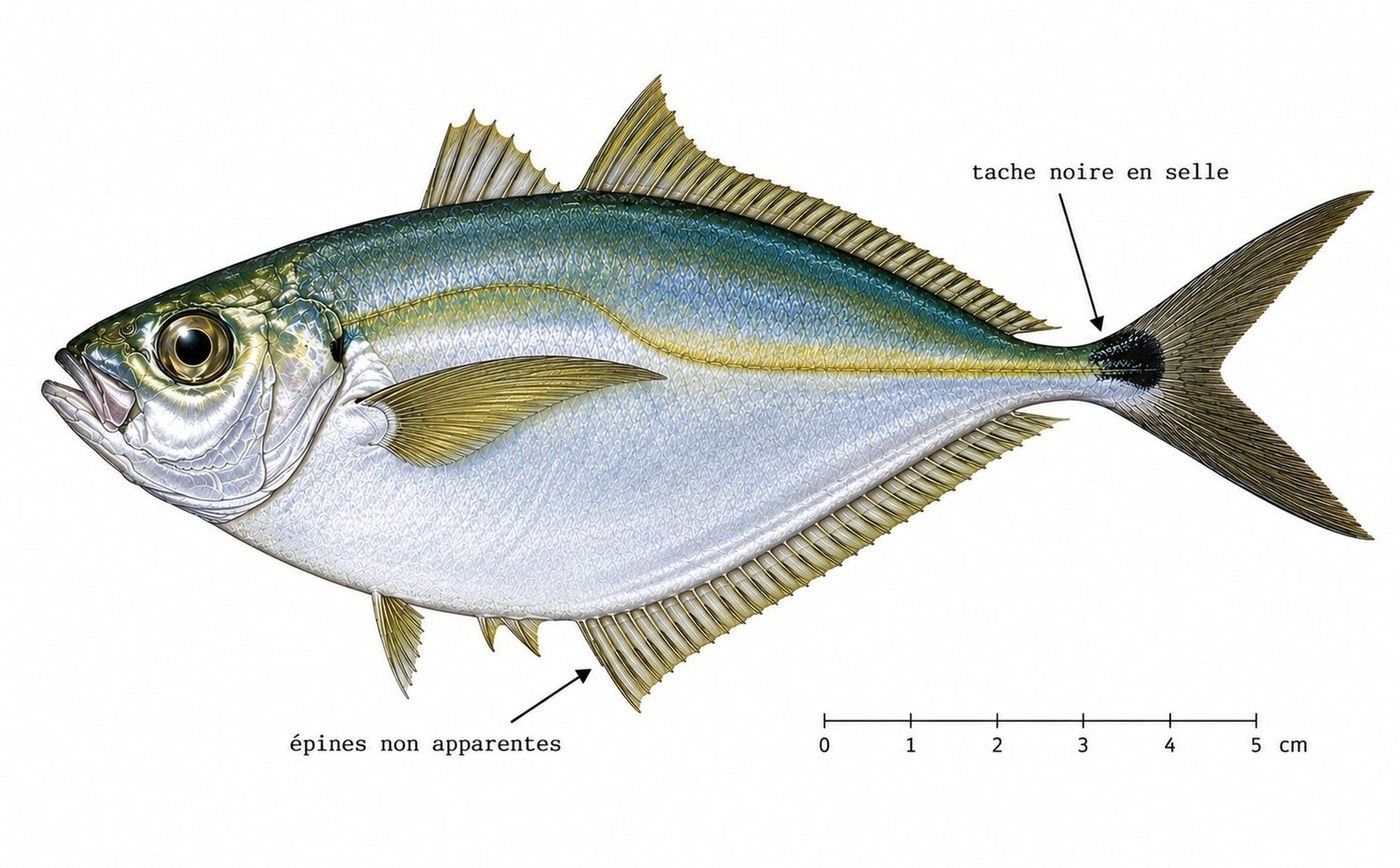
Plate: Guide de détermination des poissons des lagunes de Côte d'Ivoire (identification guide to the fishes of the lagoons of Côte d'Ivoire), E. Charles-Dominique and J. Raffray, CRO Abidjan, Archives scientifiques, 1986. Working reproduction, rights to be confirmed before publication.
Identification
A small carangid with a strongly compressed, asymmetrical body: the ventral profile is clearly more curved than the dorsal profile, the species’ instant signature. Silvery to golden livery, anal and tail fins washed with yellow. Two characteristic dark spots: a black saddle on the caudal peduncle and a spot near the edge of the gill cover. Oblique, upturned mouth.
Features that never mislead
Ventral profile much more curved than the dorsal profile, asymmetrical body.
Black saddle-shaped spot on the caudal peduncle.
Dark spot near the edge of the gill cover.
Anal and tail fins tinged golden yellow.
Size and weight
Average size around 25 cm. Maximum recorded length about 65 cm total length (FishBase). Most catches remain small.
Behaviour and ecology
A gregarious coastal pelagic species that forms large schools in the murky, productive waters of the shoreline and river mouths, down to about a hundred metres. It feeds on zooplankton, small fish and invertebrates. Juveniles often shelter under jellyfish.
Present in the Eastern Atlantic from Spain to Angola, and replaced by a sister species in the Eastern Pacific. On the Ivorian coast it is abundant in the turbid waters of the shoreline and around the Vridi canal. IUCN status of Least Concern; an abundant species exploited in mixed fisheries.
Reproduction and season
Spawns in coastal open water; pelagic eggs and larvae. Matures very early, at around 12 cm. High fecundity.
Fishing practice
Techniques, from most to least effective
Beach seines and coastal nets, commercial catches of whole schools.
With strings of small lures to catch live bait.
As bycatch in coastal trawls.
The fight: modest given its small size, but a lively sideways fight in the current. Mainly a net, market and live-bait fish.
Eating quality
Decent but small white flesh, eaten fried, braised or dried, often sold in lots. A common, popular eating fish. Eat fresh.
Sources: FishBase (Chloroscombrus chrysurus, Linnaeus 1766); IUCN Red List, LC; FAO Eastern Central Atlantic; Ouattara et al. 2016.