
Atlantic chub mackerel
Scomber colias Gmelin, 1789
Family Scombridae • the little mackerel of the Guinean upwelling
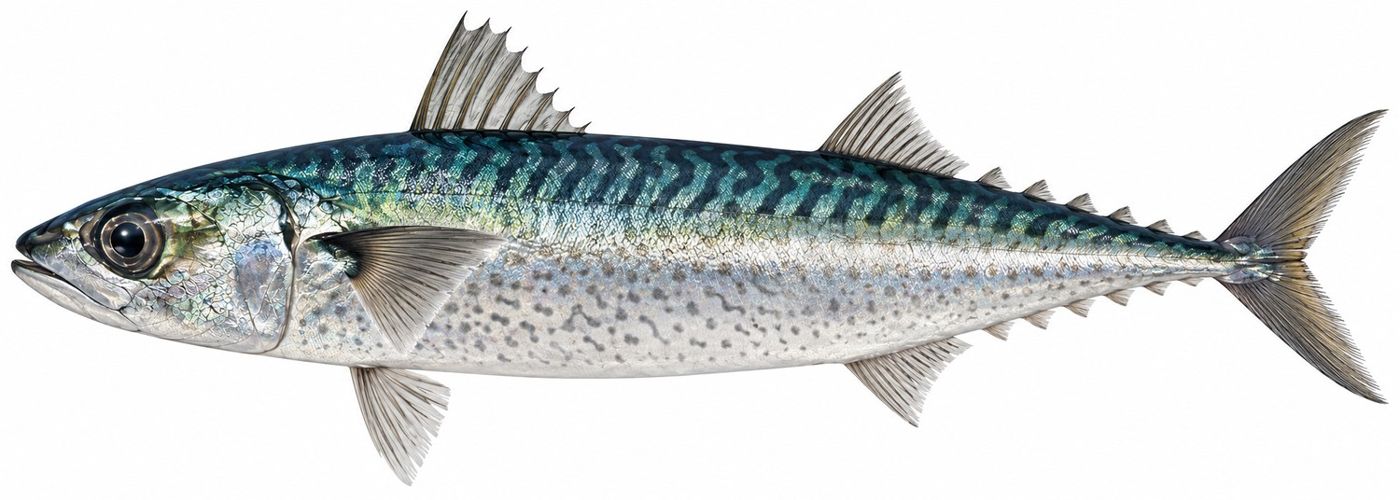
| French name | Maquereau espagnol. |
|---|---|
| Scientific name | Scomber colias Gmelin, 1789 |
| Family | Family Scombridae |
| English name (FAO) | Atlantic chub mackerel |
| Local names | On Ivorian markets and landing sites: “Maquereau” (Ouattara et al., 2016). |
| Habitat | Coastal pelagic species living in tight schools from the surface down to 300 m, most often between 50 and 200 m. |
| IUCN status | LC Least Concern. See main text of the sheet. |
Identification
Elongated fusiform body, almost round in cross-section, built for tireless schooling. Blue-green back marked with fine, dark, wavy lines that stop above the lateral line. Silvery flanks and belly, sometimes dotted with small, diffuse grey spots below the lateral line. Two well-separated dorsal fins, followed by a row of finlets to the caudal peduncle. It differs from the cold-water Atlantic mackerel, Scomber scombrus, which has no spots below the lateral line and does not occur in the Gulf of Guinea.
Features that never mislead
Back striped with oblique wavy lines that do not extend below the lateral line.
Small, scattered grey spots below the lateral line, absent in the northern Atlantic mackerel.
Large eye ringed by an adipose eyelid, pointed snout.
Five detached finlets behind the dorsal and anal fins, forked tail.
Size and weight
Common size around 30 cm. Published maximum length about 64 cm total length, with a maximum weight of around 2.9 kg (FishBase). Most Ivorian catches weigh less than 500 g.
Behaviour and ecology
Coastal pelagic species living in tight schools from the surface down to 300 m, most often between 50 and 200 m. Both a filter feeder and a predator, it feeds on small zooplankton, larvae and small fish.
Off the Ivorian coast its abundance follows the Guinean upwelling, the rising of cold, rich water that concentrates plankton and schools. A gregarious, restless, temperature-sensitive species, it forms exploitable concentrations beyond the continental shelf. IUCN status of Least Concern for the genus, but a small pelagic under heavy pressure from regional industrial fishing: local stock data to be checked with the CRO.
Reproduction and season
Spawns in open water, pelagic eggs and larvae. Its presence and abundance on the Ivorian coast increase during the cold upwelling season, roughly from July to September.
Fishing practice
Techniques, from most to least effective
With ring nets and purse seines, the dominant commercial method on schools spotted offshore.
With strings of small shiny lures (sabiki), deadly when the school is under the boat.
By light trolling of small spoons to catch live bait for jacks and Spanish mackerel.
The fight: on fine line it struggles with rapid vibrations rather than runs. Its main value remains as live bait and as an everyday eating fish.
Eating quality
Oily, tasty flesh with a pronounced flavour. Excellent grilled, braised or smoked. Very common and cheap on Ivorian markets. Eat very fresh, as the flesh oxidises quickly.
Sources: FishBase (Scomber colias; Scomber japonicus, Indo-Pacific distribution); FAO Scombrids of the World, Collette and Nauen 1983; Ouattara et al. 2016.