
Yellowfin tuna
Thunnus albacares (Bonnaterre, 1788)
Family Scombridae • the yellow-finned tuna, giant of offshore battles
| French name | Albacore. |
|---|---|
| Scientific name | Thunnus albacares (Bonnaterre, 1788) |
| Family | Family Scombridae |
| English name (FAO) | Yellowfin tuna |
| Local names | On Ivorian markets and landing sites: “Thon blanc” (Ouattara et al., 2016). |
| Habitat | Large oceanic pelagic tuna, an extremely fast swimmer capable of bursts of around 70 to 80 km/h. |
| IUCN status | NT Near Threatened. See main text of the sheet. |
Identification
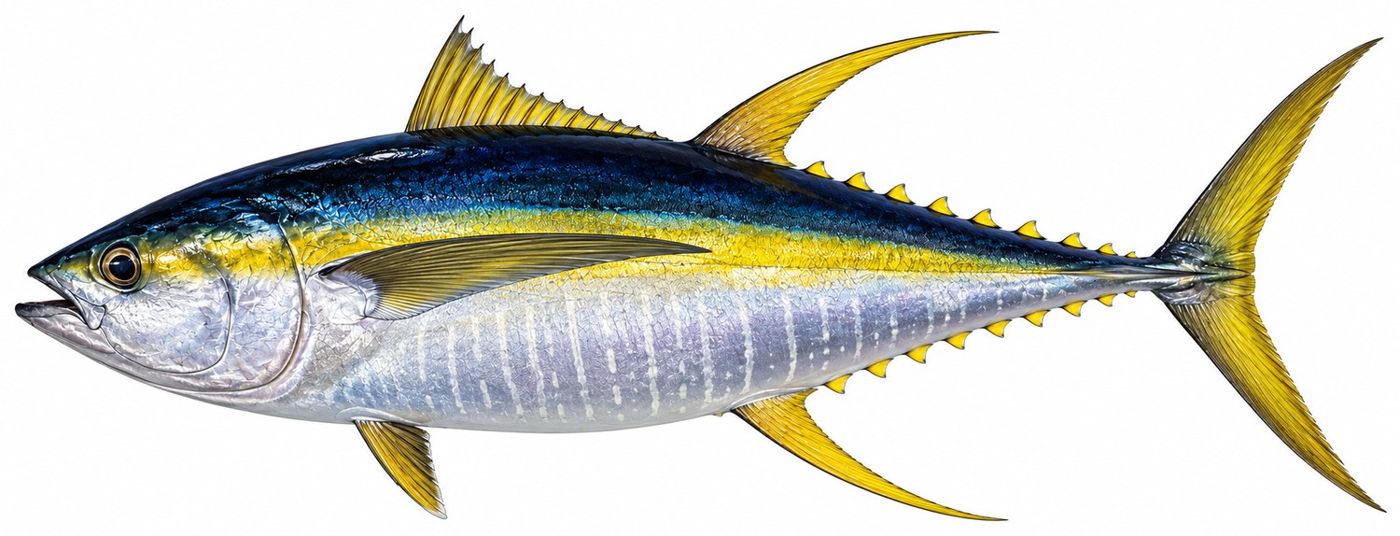
Massive, powerful fusiform body with a perfectly streamlined profile. Metallic blue-black back, golden flanks with silvery sheen, pale belly often crossed by some twenty fine, broken vertical lines. The unmistakable signature: in large specimens the second dorsal and anal fins are greatly elongated into sickles, and all the fins are bright yellow, with yellow finlets edged in black. It is mostly confused with bigeye tuna, especially as juveniles: yellowfin has a smaller eye, yellower fins and, as an adult, the long dorsal and anal blades that bigeye lacks.
Features that never mislead
Second dorsal and anal fins greatly elongated, blade-like, in adults; short in bigeye tuna.
All fins bright yellow, yellow finlets edged in black.
Golden flank, fine pale vertical lines on the belly.
Moderately sized eye, clearly larger in bigeye tuna.
Size and weight
Common size around 150 cm. Maximum length about 2.0 m total length, with a maximum weight of around 200 kg (FishBase). A fast-growing species with a life expectancy of about 8 years.
Behaviour and ecology
Large oceanic pelagic tuna, an extremely fast swimmer capable of bursts of around 70 to 80 km/h. It lives in schools often associated with dolphins, floating objects and thermal fronts. It preys on fish, squid and crustaceans, from plankton to sizeable prey.
Found in all tropical and subtropical waters, at surface temperatures between 18 and 31 degrees. A major target of purse seiners and longliners off Côte d’Ivoire, and a prized trophy of offshore big-game fishing out of Abidjan and Assinie. IUCN status of Least Concern since the 2021 reassessment, after a period as Near Threatened: the global status has improved thanks to quotas, but some regional stocks remain overexploited, notably in the Indian Ocean. Managed by ICCAT in the Atlantic.
Reproduction and season
Batch spawner in warm open water, with abundant, extended spawning near the equator. Pelagic eggs and larvae.
Fishing practice
Techniques, from most to least effective
Offshore trolling with skirted lures and diving plugs behind the boat, the great sport method of the open sea.
Heavy jigging and casting lures at surface schools spotted by birds and dolphins.
Longlining and purse seining in commercial fishing.
The fight: the benchmark opponent of big-game fishing, with very long, powerful runs, deep dives and an endurance fight that can last hours with very large fish. Heavy tackle is essential.
The trolling rig, piece by piece
- Trolling rod 50 to 80 lb, roller tip
- Lever-drag conventional reel, size 50 to 80, drag set at 10 to 15 kg
- Main line: monofilament 50 to 80 lb
- Ball-bearing swivel
- Monofilament or fluorocarbon leader 150 to 200 lb, 3 to 5 m
- Skirted lure 15 to 25 cm, resin head, single hook 8/0 to 10/0 hidden in the skirt
- Variant: diving plug with a large metal lip
Eating quality
Pale pink, firm, fine and lean flesh. Queen of sashimi and grilled loin, the basis of tuna steak. Excellent raw when very fresh, as tataki or pan-seared rare. Bleed immediately for quality.
Sources: FishBase (Thunnus albacares, Bonnaterre 1788); IUCN Red List 2021, LC, T21857A46624561; FAO Scombrids of the World; ICCAT; Ouattara et al. 2016. Illustrated rig (2026): indicative values from common sport-fishing practice (IGFA line classes, West African fishing-guide usage), to be confirmed with local anglers.